Henry Ford gets credit for the assembly line, but ask any average American or westerner about mass manufacture and they’ll tell you that Henry Ford invented all of it. Presumably everyone and everything prior to 1913 laboriously hammered, chiseled, and sawed every joint into place. But mass-production had long been employed in a variety of industries. Furniture makers had all the components of mass production nearly 150 years prior, even if their techniques didn’t quite follow Ford’s later assembly line template.
Still, the basis was there. A chair could be worked from a pattern, and the legs laid out from templates. Components like screws or joints or brass were divided among specialist craftsmen all coming together on a single set. A furniture maker’s workshop could produce dozens of variations on the same underlying design for different customers, rooms, and price points.
Thomas Chippendale saw room for improvement in the way furniture was designed, not just manufactured. And almost no one recognizes the name (except for that other group of Chippendales.)
A joiner’s son from Otley
Born in Otley, Yorkshire, England in 1718 the son of a joiner, Chippendale has mostly evaporated from the historical record. We don’t even know what he looks like, or what his early life was like. All we know is his family had been involved with timber and woodworking for the better part of at least two or three generations, and he probably picked up the trade along the way.
The first written record that survives of Chippendale comes from 1748. When American colonists were still scratching out settlement’s in Penn’s Woods, Chippendale married Catherine Redshaw, and, six years later, established a storefront workshop on the industrious and prestigious St. Martin’s Lane in London. What Savile Row is to tailors and fashion, St. Martin’s Lane is to furniture.
Meanwhile, in Penn’s Woods
Those colonists had more timber than they knew what to do with, and it changed how they built. We dug into that in America didn’t invent the wood house, but we did do a lot after the invention of the nail.
There, Chippendale employed a modest 50 carvers, gilders, upholsterers, and other specialists working on cabinets, upholstery, tables, bookcases, mirrors, beds, and nearly all other architectural furnishings.
1718
Born in Otley, Yorkshire, the son of a joiner
50
Carvers, gilders, upholsterers and other specialists on St. Martin’s Lane
160
Engraved plates in the first edition of the Director, 1754
308
Subscribers to that first edition, 49 of them aristocrats
An open-source furniture catalog, in 1754
In 1754 Chippendale took an unusual step by publishing The Gentleman and Cabinet-Maker’s Director. The “book” contained 160 engraved plates that covered an astonishing range of styles and furniture, from Gothic to Chinese and what he called “Modern” taste that derived from a quirky French style we now call Rococo.
Furniture designs in print weren’t new. People had seen drawings of chairs and tables in catalogs and pamphlets, of course. But nothing on this scale and level of open-source distribution had ever happened before. Chippendale’s plates had texture, sheen, and depth. A gentleman in Yorkshire, or a wealthy American colonist across the ocean could now see the same visual information and imagine exactly what that piece would look like in their home.
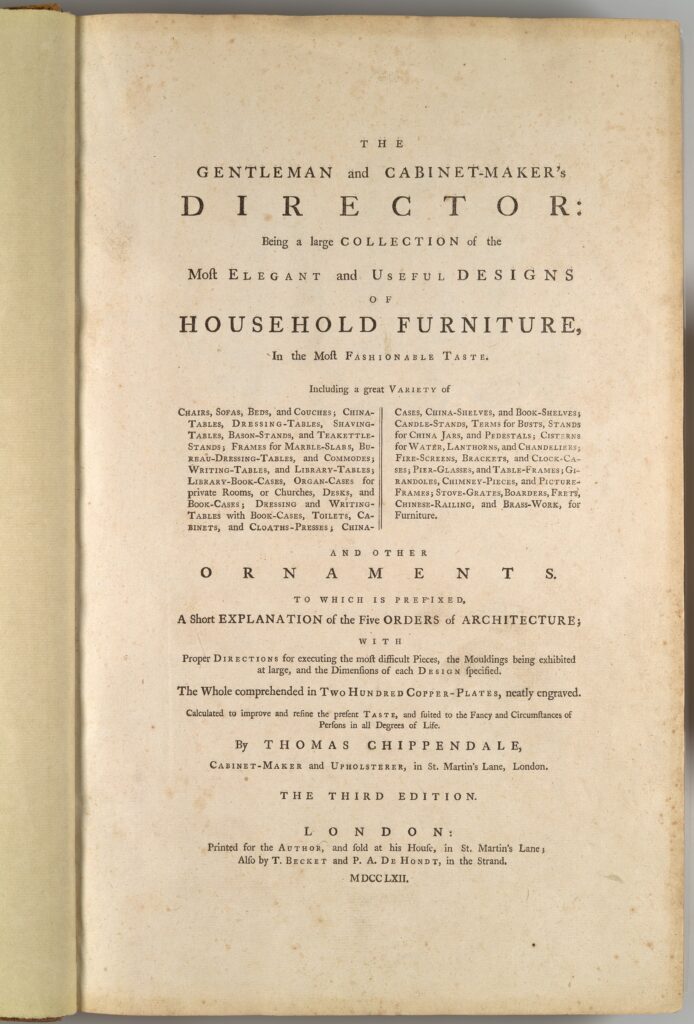
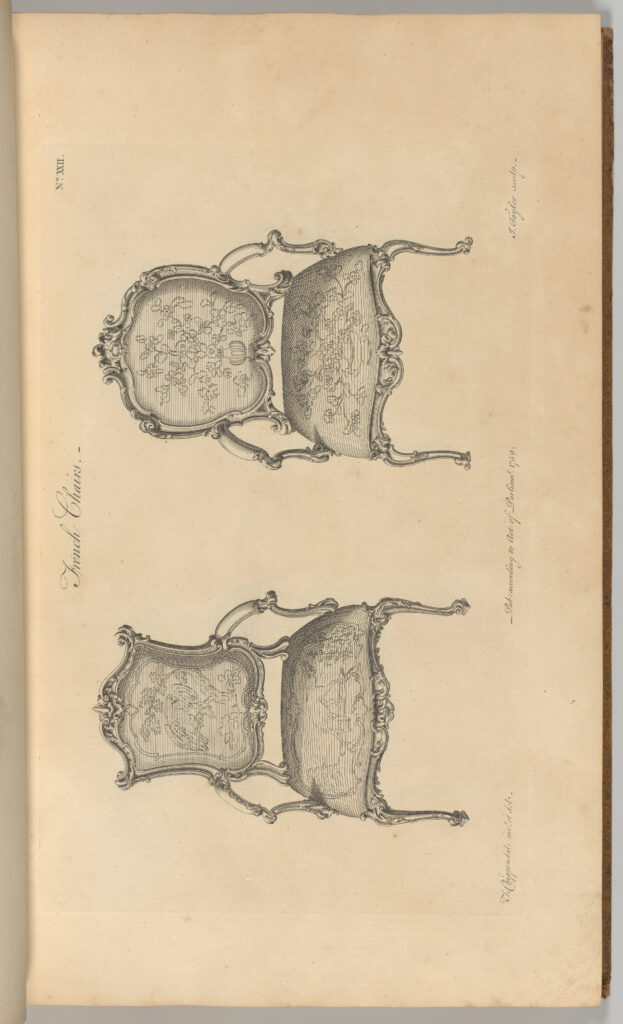
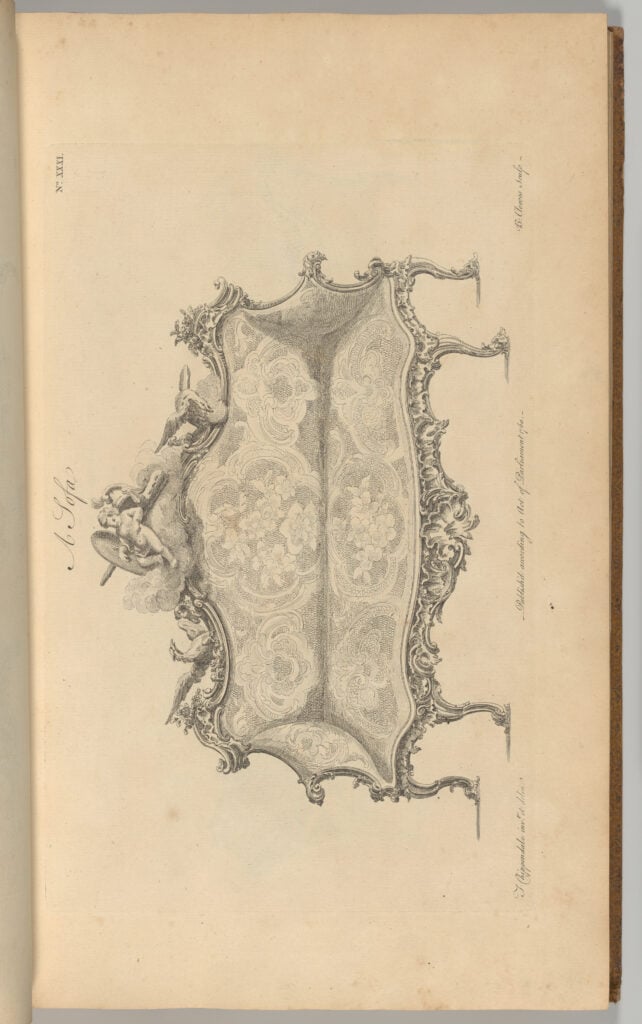
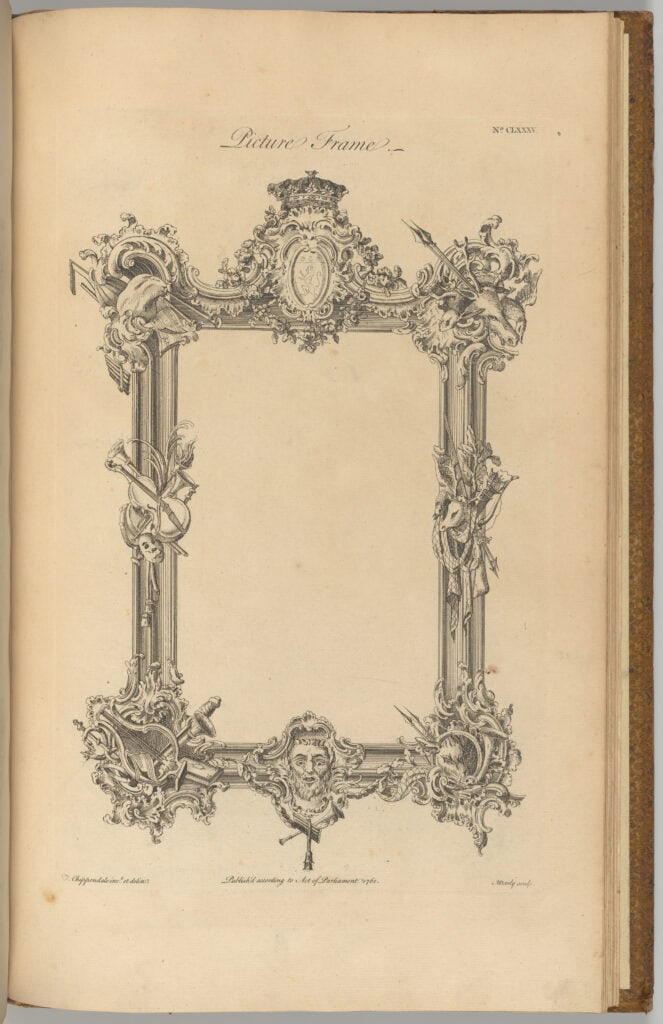
Chippendale only found 308 subscribers of his book, mostly direct order from other craftsmen. But 49 buyers were among the aristocracy, making it hugely influential with all the most admirable people in the English empire. All this openness sounds insane as a business model, and it was, but Chippendale created one of the earliest established brand names at a time when most pieces carried royal names like “Queen Anne” or “Tudor Style”. Akin to how people today can copy a Louis Vuitton or a Rolex, there’s only one originating source that you generally trust to be the fullest quality.
All his open design work was novel, and has been hugely frustrating for furniture historians ever since. A piece today described as “Chippendale’s” is assumed to have come from his own workshop, though not necessarily from his hands. But it could also come from a competing workshop, as many customers locally and abroad paid lower prices from lesser furniture makers for a good-enough piece.
Gothic, Chinese, or Modern?
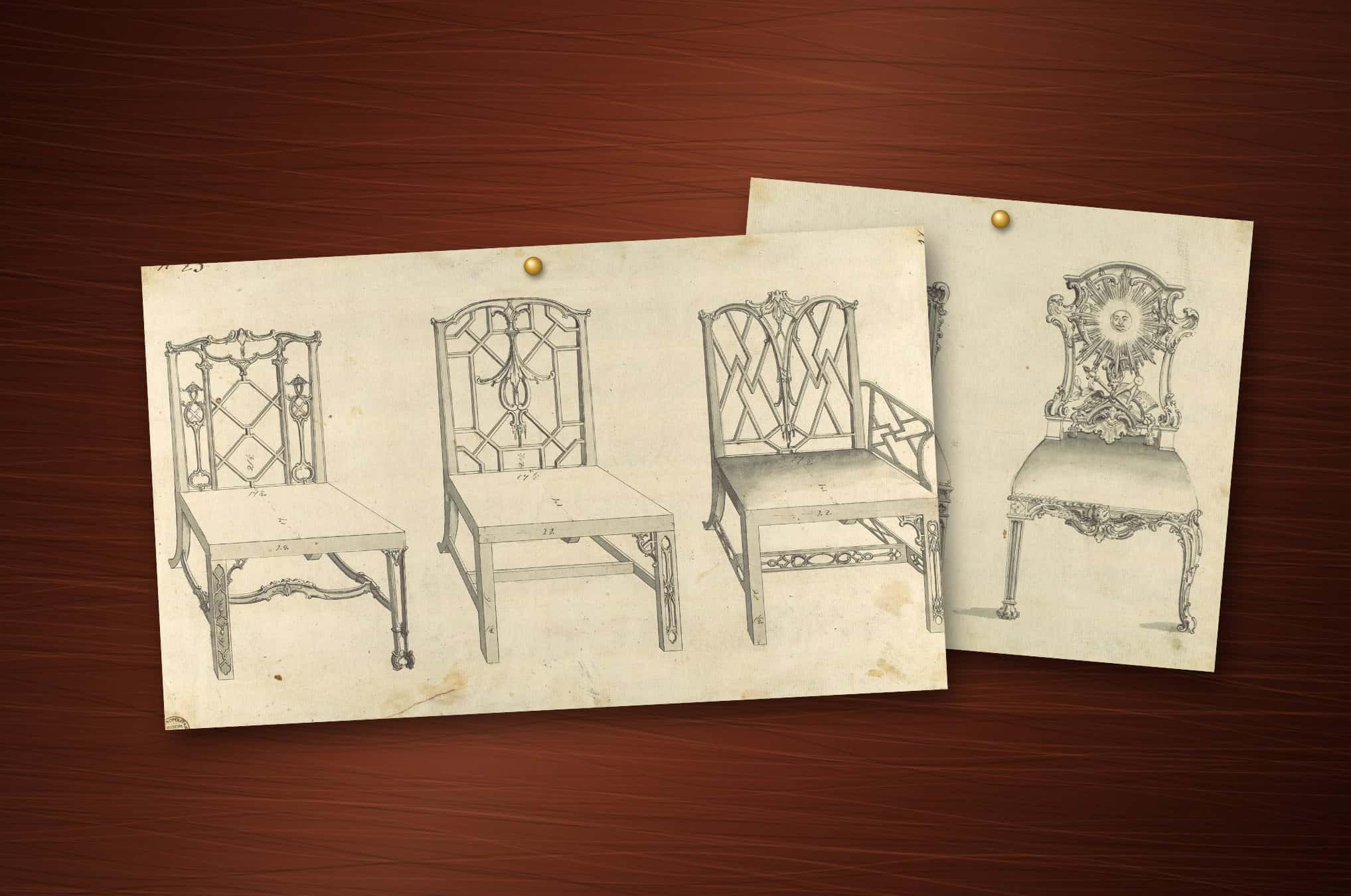
The Director sorted its designs into three “tastes.” Below are three of Chippendale’s own preparatory drawings. Guess which taste each one belongs to, and try not to let the lattice fool you.
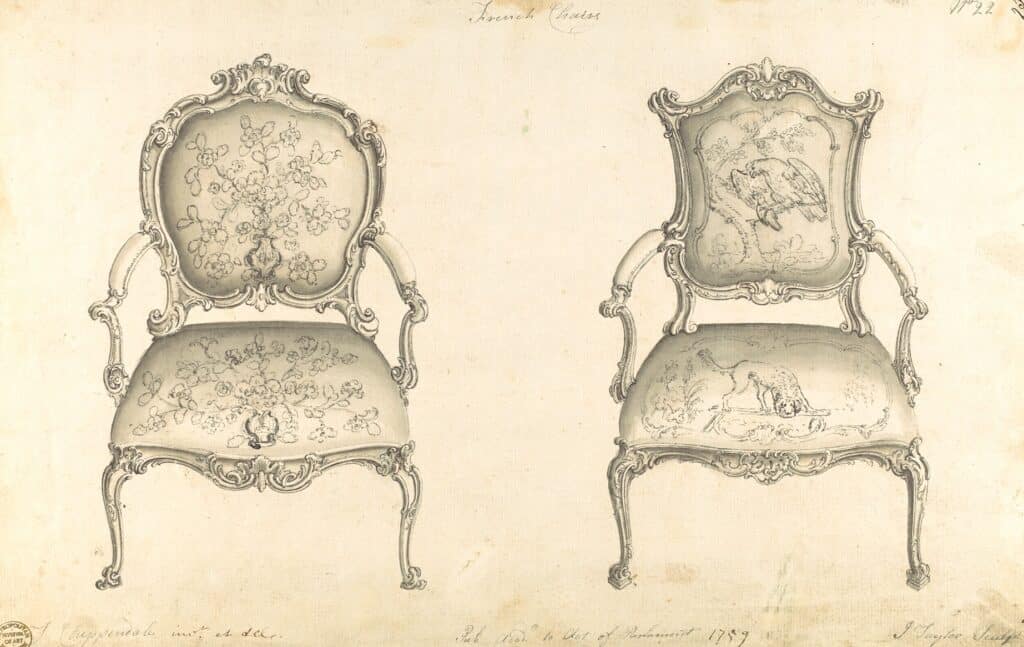
Drawing A, 1759
Modern, or what we now call Rococo. Chippendale filed these under “French Chairs,” and the upholstered seats, cabriole legs and carved C-scrolls are the French-inflected look the Director called the Modern taste. Those legs are doing most of the flirting.
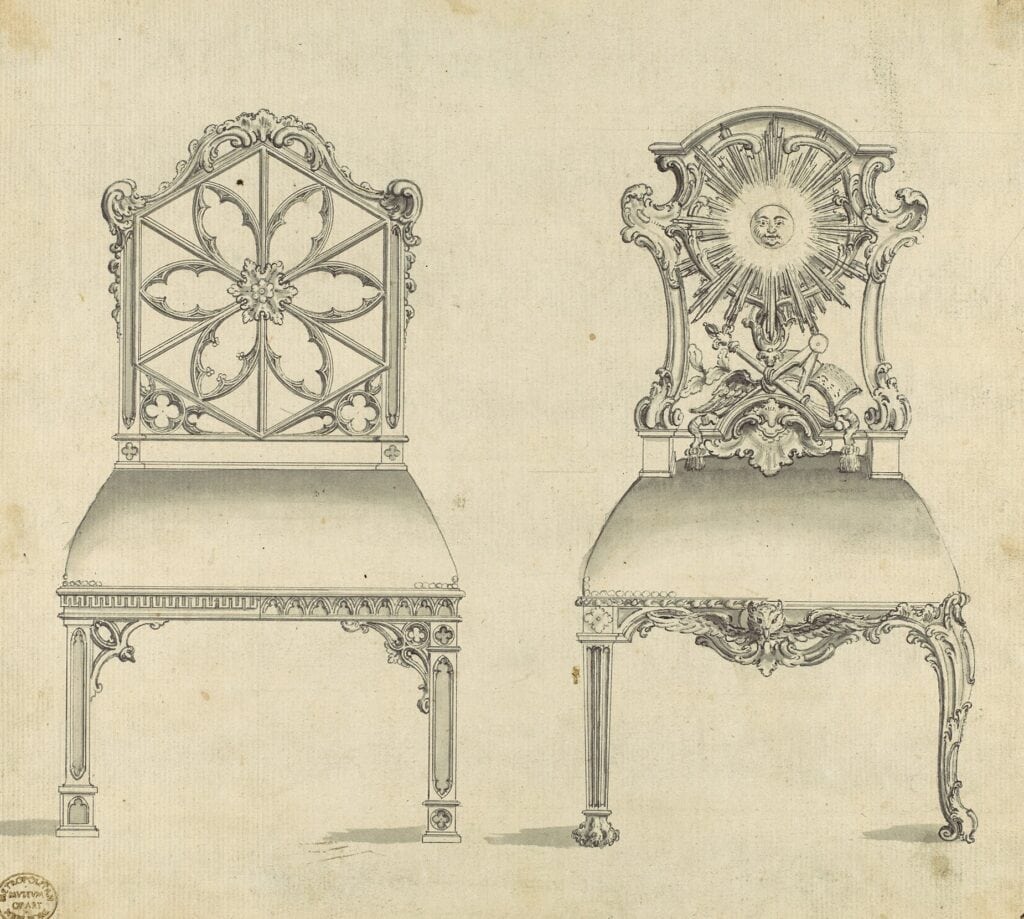
Drawing B, 1761
Gothic, which Chippendale spelled “Gothick,” with a k, arguably the most Gothic thing about it. The tracery on the left borrows from cathedral rose windows and shrinks them down to hold up a seated person’s back.
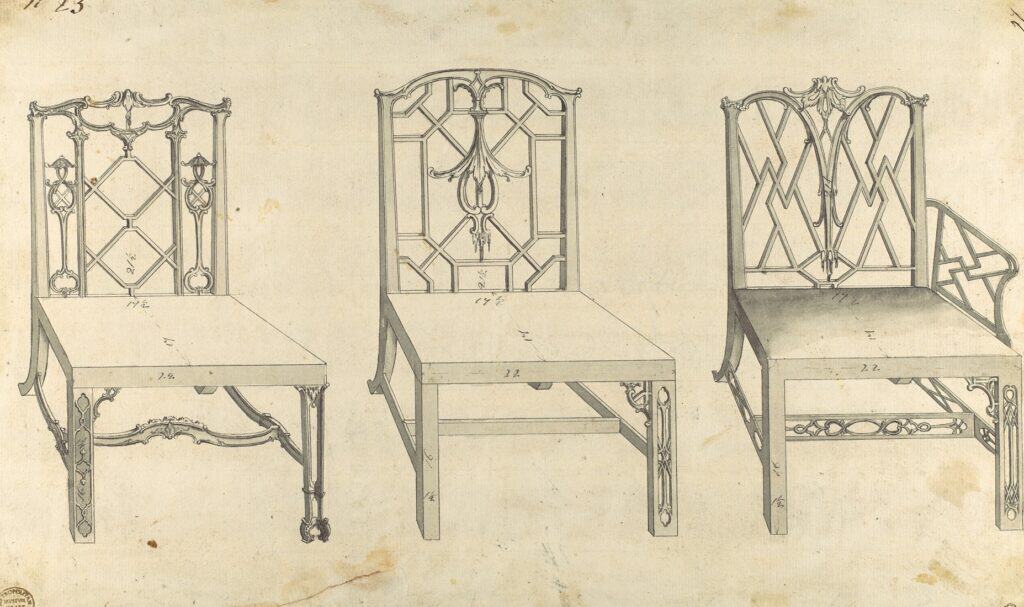
Drawing C, 1753
Chinese. The geometric lattice, or fretwork, backs and straight legs were Georgian London’s idea of China, dreamed up largely from imported porcelain, lacquer and wallpaper rather than from anything a London joiner had actually sat on.
Drawings by Thomas Chippendale from Chippendale Drawings, Vol. I, The Metropolitan Museum of Art, Rogers Fund, 1920 (public domain).
When a name becomes a style
The designs circulated widely in Britain and abroad, particularly in North America, until ‘Chippendale’ became less the name of a maker than a generic label for an entire family of eighteenth-century furniture
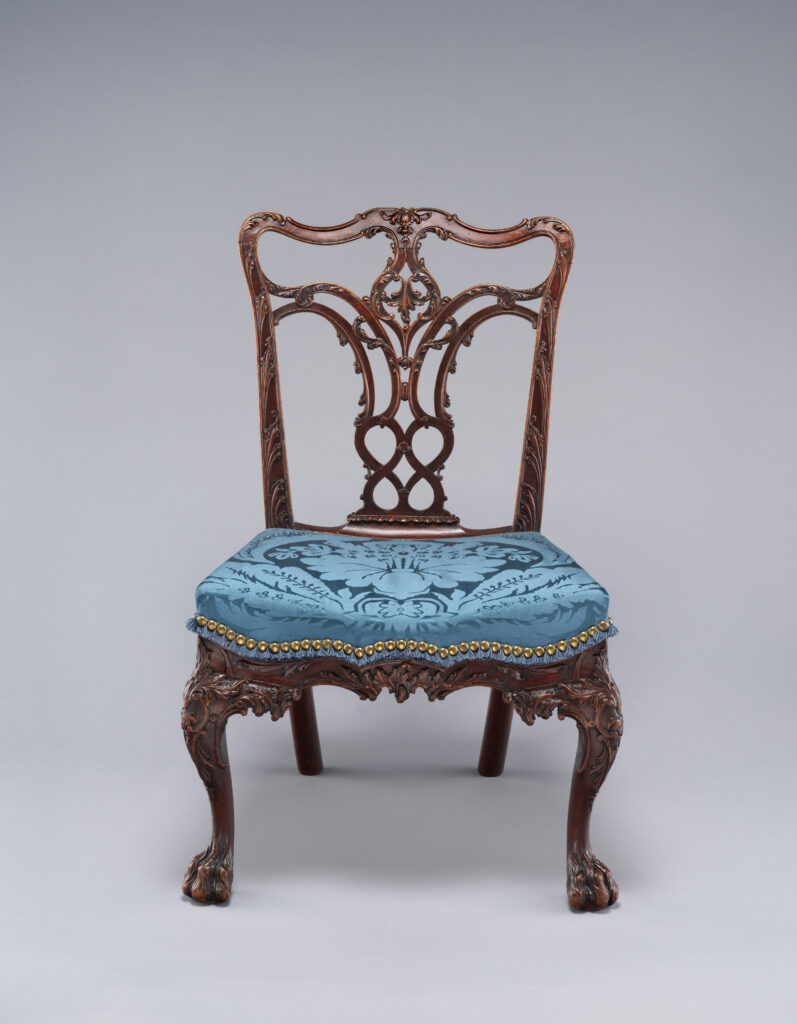
One particularly exquisite example appeared at Sotheby’s in New York in 2007 when a stunning Boston mahogany desk-and-bookcase, made around 1756 that had remained in the Deblois family for roughly 250 years, sold for $3,288,000. The desk came with carving attributed to Boston carver John Welch. Thomas Chippendale did not make it, and it did not come from his workshop. Yet it belonged unmistakably to the design world his Director helped create.
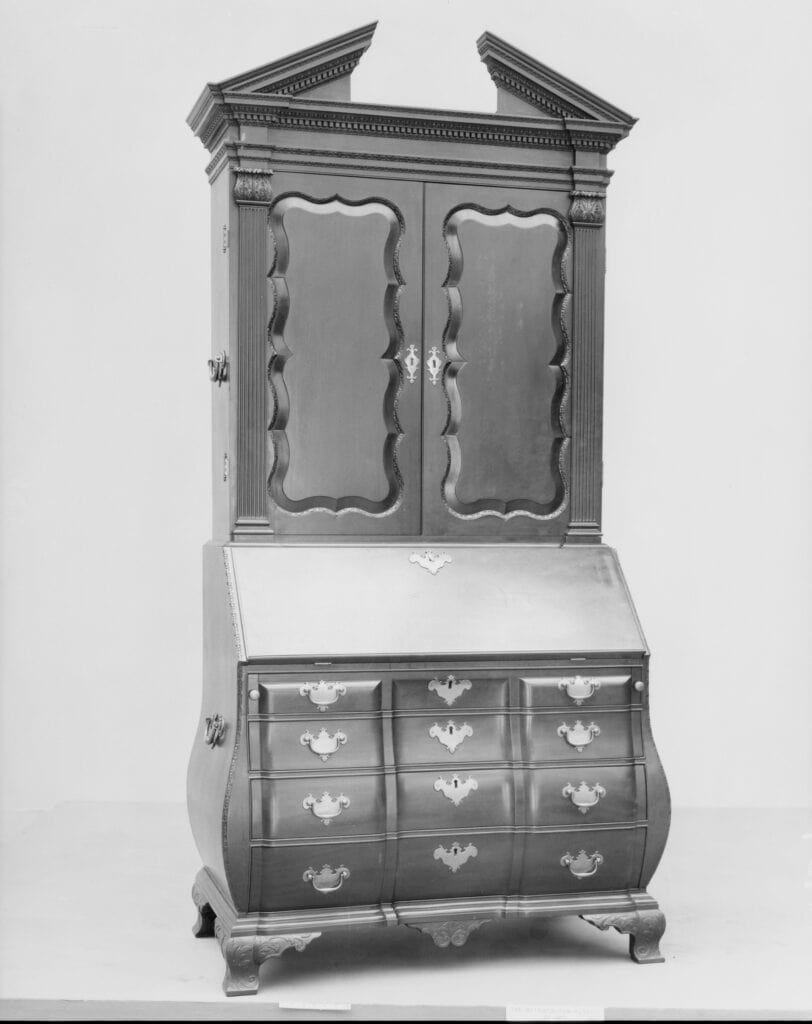
$3,288,000
paid at Sotheby’s in 2007 for the Deblois family’s Boston desk-and-bookcase
≈ 47
Chippendale estates, using the roughly $70,000 he was worth when he died in 1779. The man who popularized the look could not have bought a single drawer of the copy.
Chippendale had stumbled or discovered, it’s hard to say, into the notion you can lose control of a design and still own the idea.
Hepplewhite, Sheraton, and the pattern-book crowd
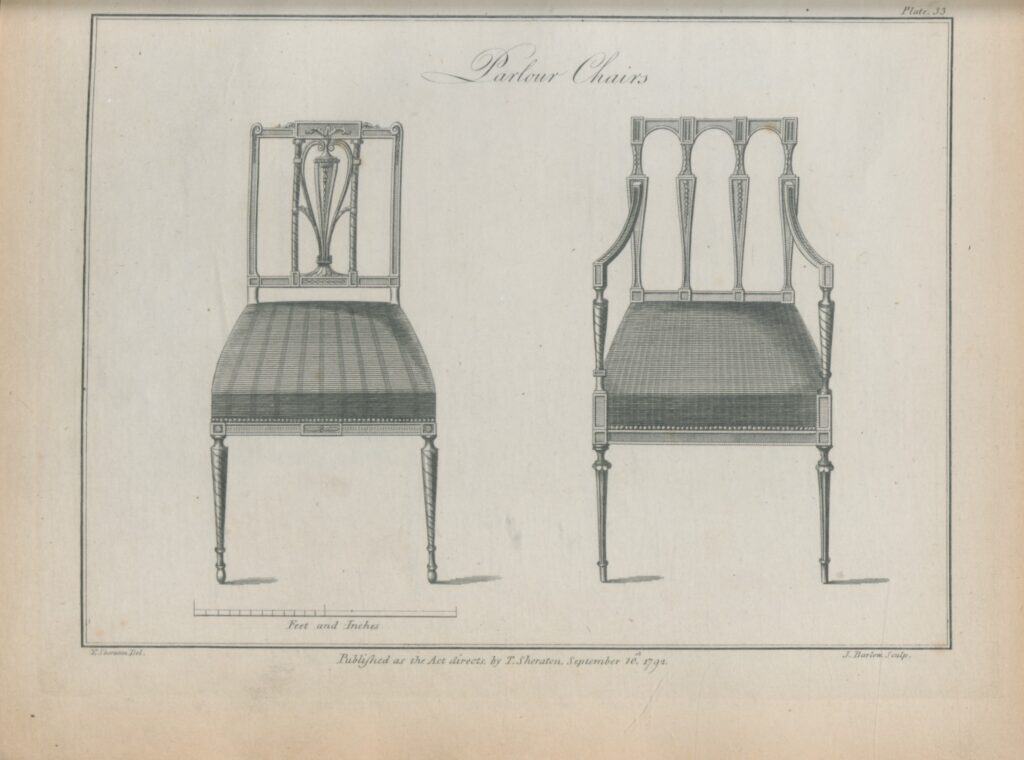
George Hepplewhite and Thomas Sheraton were two such examples. They both had cabinet maker and furniture maker pattern books of their own, and Sheraton’s had twice as many subscribers as Chippendale’s and it was translated into German. Hepplewhite and Sheraton became particularly popular in America.
Swietenia, the wood that made the look
Part of their and Chippendale’s success is owed to Swietenia mahogoni, a wood that’s nearly been sourced out of existence from parts of the Carribbean. Caribbean people obviously knew the mahogany tree long before Europeans arrived. Spanish colonizers encountered the timber in the early colonial period and knew it as caoba. Mahogany was being used in the Spanish world centuries before Chippendale was born. Some surviving documentary evidence places Caribbean mahogany in Spanish architectural and furniture work by the late sixteenth century.
English folklore later produced a more romantic discovery story involving a piece of mahogany supposedly brought home after one of Sir Walter Raleigh’s voyages and a carpenter who unexpectedly discovered its qualities.
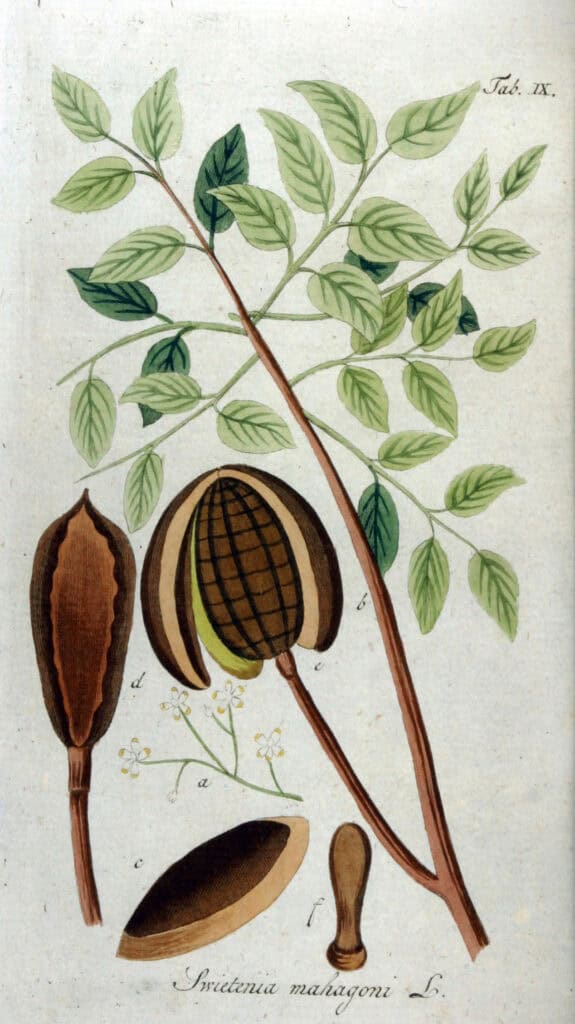
But to this day, Swietenia and its three related species as a specific species of mahogany has never been matched for richness, elegance, and utility. It was used so rapaciously that it almost immediately went extinct within 50 years.
It is difficult to overstate how well suited the best old-growth examples of Swietenia were to furniture. The world may one day produce better chair makers than ever before, but it will never produce finer chairs or wood.
The heartwood ranges from warm pinkish brown to deep red-brown and grows darker with age. The grain may be straight, wavy or interlocked. Under changing light it can display chatoyance—the optical shimmer familiar in silk, cat’s-eye gemstones and certain highly figured woods—so that a polished surface appears almost to move as the viewer moves past it.
Try it yourself
How a log is sawn has a lot to do with how much shimmer and figure you see. Spin up our interactive quarter, plain, rift and live sawn wood cutter to watch one log turn into four very different-looking boards.
It’s stunning sheen and appearance was only the beginning. Swietenia mahogany was dense enough and strong enough to hold elaborate carving, and yet remarkably pleasant to work. It could be sawn, carved, turned, sanded, glued and finished with comparatively little resistance. It took a superb polish. Its fine, uniform texture allowed tiny details to remain crisp instead of crumbling away from time or light use.
As any wood moves, it absorbs and releases moisture, thus swelling and shrinking across the grain as humidity changes. Swietenia was unusually stable. Moisture changes is one of the most fundamental constraints on furniture design as broad panels split; joints loosen; thin sections distort. Swietenia mahogany had remarkably low shrinkage and a robust relationship between radial and tangential movement. Thus a properly seasoned piece tended to remain where a cabinetmaker put it, and it stayed that way seemingly forever. Many species of mahogany carry some of these properties today, and it is still beautiful. But the combination that Swietenia brought together has never been replicated.
The humidity dial
Every board in a piece of furniture swells in damp weather and shrinks in dry weather. Pick a panel width, then drag the humidity from a parched, furnace-heated January to a muggy August, and watch how much each wood moves compared with the day it was finished at a comfortable 40% relative humidity.
Board movement is exaggerated 15 times so you can actually see it; the navy line marks the panel’s width on finishing day. Estimates use tangential (flatsawn) shrinkage from green to oven-dry, as published by The Wood Database, and equilibrium moisture content at about 70°F from the USDA Forest Products Laboratory’s Wood Handbook, with the common rule of thumb that movement is roughly proportional to moisture change below a fiber saturation point of about 30%. Modern Cuban mahogany figures come from today’s trees, not from the old-growth logs Chippendale’s workshop used, and real pieces vary with grain, finish and seasoning.
Why wood moves at all
It comes down to cellulose, hemicellulose and lignin and how they hold on to water, which we unpack in What is wood made of anyway? And why is it so good for building stuff?
A Chippendale chair could therefore become lighter visually without becoming correspondingly fragile, and his timing was such that Britons and colonies knew of the wood, loved its look, craved lots of it, and wealthy people had the means (through enslaved labor) to combine rare wood with great design.
Not extinct, but not coming back anytime soon
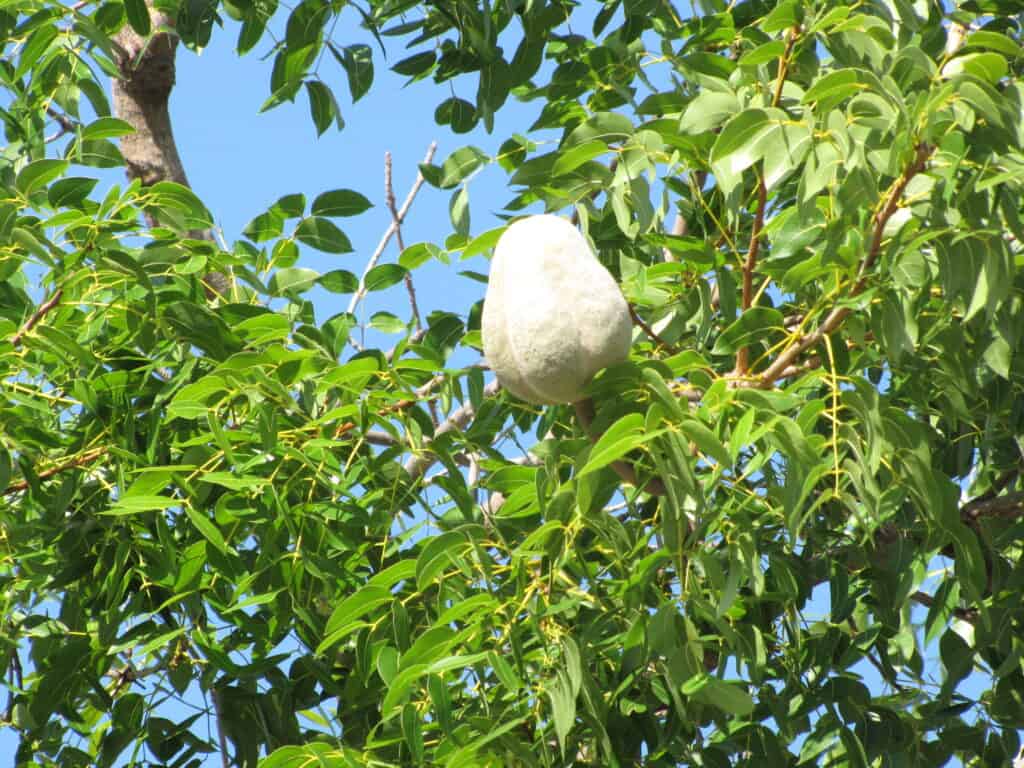
Swietenia mahogani isn't extinct, yet, but all its old growth is, at least for our lifetimes. The historic commercial resource of huge old-growth trees was catastrophically depleted and historic-scale lumber is effectively unavailable commercially. It is classified as Near Threatened in the IUCN information carried by Kew and its international trade is controlled under CITES Appendix II. In the Cayman Islands, for example, Kew notes that massive trees formerly grew with trunks a meter or more in diameter and that nearly all such large, ancient specimens have long since been cut. Centuries of selective logging cut all the best trees with the richest color and durability.
If you miss old-growth looks
Decorative surfaces can now capture and reproduce timber that is scarce or long gone. See how in Interprint captures and preserves the beauty of long-gone timber, and for the bigger picture on how forests get managed (and mismanaged), read Forgotten and misunderstood forestry management is fueling wildfires and high housing costs.
A brilliant designer and a hopeless bookkeeper
Like the finest Swietenia, many of Chippendale's history has been lost or severely eroded. Some of Chippendale's pieces spent years rattling around servant and slave quarters before being rediscovered. Chippendale was hopeless at running a business after his business partner James Rannie died in 1766. Left lurching crisis to crisis and seeking ways to pay his men, his workshop continued producing work from some of the leading designers like Sir William Chambers and James Wyatt. Customers were slow to pay, and Chippendale had to threaten legal action against some of England's most well-known celebrities of the day.
When Chippendale died in 1779 he was worth about 230 pounds (about £52,000, or $70,000 in 2026). It was, and remains, not an easy age to do business, and a reminder that even as design is "reproducible", materials often are not.