Podcast: Download (Duration: 38:07 — 87.2MB) | Embed
Subscribe: Apple Podcasts | Spotify | Android | RSS | More
About this episode
In part two of our Formica series, Christelle Locat-Rainville, Marketing Director for Formica Canada and Commercial Leader for Sustainability at Formica Corporation, joins host Kenn Busch to dig into the sustainability story hiding inside high-pressure laminate, and why the industry has done such a poor job of telling it.
Start with the ingredients: HPL is 60 to 70 percent paper. Kraft paper saturated with phenolic resin sits under a melamine-saturated decorative sheet, a recipe that has barely changed in more than a century. That paper comes from fast-growing pulp trees in managed forests, the wood fiber in it is roughly half captured carbon, and printed, textured wood grains let designers celebrate rare species without cutting them down.
From there the conversation moves to life cycle assessments, why the particleboard and MDF beneath the laminate can store more carbon than their production releases, how durability and reuse keep furniture out of the landfill, and why architects and designers, who write the specs, have the most power to change the outcome.
Learn more about Formica Corporation’s sustainability commitments:
- Corporate Commitment | Formica
- Sustainability documents and certificates | Formica Group
- Formica Corporation Highlights Strong Sustainability Progress in 2025 Broadview Group Position Paper
The following podcast transcript was generated with Whisper AI and may contain errors.
Transcript
Kenn Busch in conversation with Christelle Locat-Rainville, Marketing Director, Formica Canada, and Commercial Leader, Sustainability, Formica Corporation.
[00:09] Christelle Locat-Rainville: I think the positive side of this is architects and designers who create and who dictate what’s going to be included in the building, inside and outside, they have a way to change the world.
[00:24] Kenn Busch: Wow. No pressure, architects and designers.
[00:28] Kenn Busch: I’m Kenn Busch. This is the Material IQ podcast. Our topic today is sustainability in surfacing materials, specifically HPL. My partner for this episode is the Formica Corporation, and my guest is…
[00:43] Christelle Locat-Rainville: Christelle Locat-Rainville. You could say Christelle, if it’s easier.
[00:51] Christelle Locat-Rainville: So I am the Formica Canada marketing manager, and I am the North America sustainability commercial leader. So I have a dual role.
[01:03] Christelle Locat-Rainville: The sustainability portion of my role came from a personal interest of always making sure I can do my best to have no footprint, if I can. I know we all have one, but to have the lightest footprint that I can have. So it’s a personal interest first, but then I started learning about sustainability and started taking trainings about it.
[01:28] Kenn Busch: That’s incredible. I didn’t know this. So you had this varied background, and sustainability was really a passion of yours before it became a profession, which I think is really super cool. And that’s what this industry needs, honestly.
[01:42] Kenn Busch: You mentioned B2C as well as B2B. I think that’s really important, because this industry has probably the best sustainability story of any product category, but we’re doing an awful job of sharing it with the design community, and of course with consumers as well. So your background is kind of just perfect.
[02:04] Christelle Locat-Rainville: I’m the typical person who will say to people, why would you buy that? Do you really need it? And can you switch to a hard soap to wash your hair instead of buying the plastic bottles? But I’m doing it for myself, to be as sustainable as I can and to reduce, again, the footprint that I can leave.
HPL is mostly paper
[02:24] Kenn Busch: So I want to get into the first point of order. HPL is mostly paper. And for some reason, we’ve been keeping that a secret.
[02:34] Christelle Locat-Rainville: Okay. So HPL, high-pressure laminate, is made of paper. It has always been made of paper. The total composition of the laminate sheet might have changed over the years, but the majority, between 60 and 70%, is paper: kraft paper and the decorative layer on top. That paper build-up comes to 60 or 70%, and the rest, about 30%, is the resins, different types of resins for different applications, different properties, different features and benefits. But it’s made of paper.
[03:12] Kenn Busch: There’s this really interesting tool I’ve seen out there. It is a sheet of HPL that was left half out of the press. So half of it feels like a finished piece of HPL, and the rest of it is all these layers of paper.
[03:24] Christelle Locat-Rainville: We call it the feather deck. So we show a little piece of HPL that has not been fully cooked, so you see the different layers, and people realize, oh my gosh, it is paper. I can touch it. I can see the different layers.
[03:40] Christelle Locat-Rainville: And I think the beauty of high-pressure laminate being made of paper is that everyone knows what it is, versus other materials where it’s an aggregate of XYZ, and you’re like, okay, but what is that? Paper, everyone knows. You have a visual, you’ve touched it, you’ve seen it. Easy. So I think that’s something that we benefit from.
[04:00] Kenn Busch: Did you say it’s a feather deck? Did I hear that right?
[04:03] Christelle Locat-Rainville: I mean, that’s the internal lingo for it. It’s probably not the official name.
[04:06] Kenn Busch: No, no, but yes, it’s half cooked, right? There’s the high-pressure laminate as we understand it on one half, and the other half is almost like an exploded view of what’s in there, which is several layers of paper. And the kraft paper is like shopping bag paper, right? Am I close?
[04:25] Christelle Locat-Rainville: It’s brown.
[04:26] Kenn Busch: It’s strong. Kraft is the German word for strength, or strong, I think. But what else should we know about that part of it?
[04:35] Christelle Locat-Rainville: I would say it’s strong after it’s been impregnated with resin. But before that, as you say, it’s really similar to a grocery bag. Of course with some differences, but the visual people can put in their mind to see what kraft paper is, is a grocery bag. And then the decorative layer is a really, really thin paper that is either a solid color or a pattern that represents a stone or a wood grain.
[05:04] Kenn Busch: And this is the same basic makeup that it’s been for a hundred years or more, right?
[05:10] Christelle Locat-Rainville: What’s interesting is we haven’t evolved the build-up of high-pressure laminate since it was created. We’ve seen so much evolution in so many industries and products, but high-pressure laminate was created using paper and a decorative layer with resin, and that hasn’t changed. Everything around it has changed and evolved and improved, but what I call the build-up is exactly the same. Can you imagine how amazing that recipe was, not to change for more than 110 years?
Phenolic, melamine and the press
[05:46] Kenn Busch: Yeah, you can’t improve on it. When you look at this feather deck, you can see the different ingredients, and each of those layers of paper, whether it’s the kraft or the decorative layer, has already been impregnated with one kind of resin or another, right? Do you want to tell us a little bit about the different resins used in the different layers?
[06:11] Christelle Locat-Rainville: So the kraft paper is impregnated with phenolic resins, and the decorative layer is impregnated with melamine. Melamine. That’s where my French comes in.
[06:26] Kenn Busch: Yeah.
[06:27] Christelle Locat-Rainville: So melamine is for the top layer with the decorative paper. Then we put that all together and press it under high pressure at a really high temperature. And what we call it internally, once it has gone through the presses, is cooked. Fully cured. A better way would be to call it cured, but I like to call it cooked.
[06:49] Kenn Busch: Yeah. And it’s delicious.
[06:53] Kenn Busch: Well, and there’s a little bit of a difference. You said the kraft paper layers are saturated with a phenolic resin and the decorative layer is saturated with a melamine resin. And the reason for that, I believe, is that the phenolic resin makes the kraft paper flexible and easy to handle. But phenolic resins don’t cure, or cook, clear. They cook brown, right? They change color a little bit. Is that true?
[07:24] Christelle Locat-Rainville: It changes color a little bit. And as I said, each resin has its own advantages or features. To be honest, it would be easier to just put all the papers in the same resin and be done. But we have a dual process, where the kraft paper goes through a series of basins and ovens, and the decorative paper goes through another set of basins and resins, and then we put them together.
[07:50] Christelle Locat-Rainville: So the phenolic makes it, as you say, more flexible, and easier to fabricate compared to melamine. It’s also why we can do some radius with HPL.
[08:05] Kenn Busch: Postforming.
[08:06] Christelle Locat-Rainville: Exactly, postforming, the radius, whatever you do. You can wrap a column with HPL. Not everyone knows that, but it’s flexible to the point where you can wrap a column in a commercial setting, for example.
[08:18] Christelle Locat-Rainville: And then the melamine resin gives it the impact resistance. It’s really easy to clean laminate, and that’s also due to the resin that we use. It’s going to be scratch resistant as well. A lot of things come from the resin.
[08:37] Christelle Locat-Rainville: And then the design, the decorative aspect, is due to the plates that we use when we cook the laminate. We put the sheets between plates, and the plates give the texture to the top layer, the decorative layer of the laminate. So that’s pretty much how it works.
[09:02] Kenn Busch: Yeah. And the melamine resin is more brittle when it’s applied to the paper, but it cures, or cooks, perfectly clear, right? So that’s why it’s on the decorative layer, because it doesn’t interfere with the design or the color on the paper. And so the combination of the phenolic-saturated papers and the melamine-saturated decor layer works in perfect harmony to create this very easy to handle, but very durable, very scratch-resistant sheet of decorative surface.
[09:39] Christelle Locat-Rainville: And as we were saying, it’s been like that for years and years because it’s a perfect recipe. What’s interesting is we haven’t changed it for the core HPL products, but we’ve taken some portions and evolved the resins and the paper to create new product categories, new features, new benefits. One example would be products that are fingerprint resistant, super matte. Those use acrylic, so it’s a different mix of resin because the properties are different.
[10:28] Christelle Locat-Rainville: So when I say it hasn’t evolved, that’s not quite true. What I mean is it hasn’t evolved in terms of the build, but everything around it has evolved a lot.
A substitute for mica
[10:39] Kenn Busch: And we should back up. You mentioned this was really created in 1913, but it wasn’t a decorative surface back then. It was an electrical insulator. It was created as a more, I was going to say sustainable, but they weren’t talking about that back then, a more practical solution for the material that was commonly used for electrical insulators, which was the stone mica. So this was a substitute for mica. And that’s probably what drove how technically perfect it is, because it had to be an industrial material first.
[11:20] Kenn Busch: And the bottom line here, what we really want to leave the audience with, is that high-pressure laminates are 70% paper. Even though people like to use the word plastic with them, they’re actually mostly paper.
[11:39] Christelle Locat-Rainville: Since we’re talking in general about high-pressure laminate, I think we have to make sure we say between 60 and 70%, because not all high-pressure laminates have the same bio-based content or the same quantity of paper in the build-up. So to be really fair, let’s say between 60 and 70%. Then I think we’re covering the whole spectrum.
Pulp trees, managed forests and rare species
[12:04] Kenn Busch: Okay. So we’re here to talk about sustainability, starting with the fact that HPL is roughly 70% paper. And of course this is paper from lower-value trees, right? Pulp and paper trees sourced from managed forests, at a time when we aren’t using as much paper as we used to. Monetizing the harvest and removal of pulp and paper trees actually keeps the overall forest a lot healthier and opens up room for the hardwood trees, the higher-value trees, to grow tall and straight. So in that way, the ingredients that go into HPL actually help the hardwood industry.
[12:44] Christelle Locat-Rainville: Yes, exactly. It’s a system. It’s a balance. And we are part of this ecosystem. People are not going to stop using paper. They’re not going to stop building with wood. So we have found a balance. We just have to make sure more people understand the meaning of this balance.
[13:05] Kenn Busch: Exactly.
[13:06] Christelle Locat-Rainville: And in the balance are also rare species. Knowing that HPL can replace rare wood species or rare stone, or really anything, means it replaces the real thing. So in a way it is a sustainability story just in this aspect. Whether I’m talking about stone or about a tree doesn’t really matter. You want to keep those things where they are, and you don’t want to touch them. So using high-pressure laminate to replace them is a great story.
[13:52] Christelle Locat-Rainville: Just like it started, as you say, as a replacement for a rare mineral, mica. That was so brilliant at the time. We didn’t invent anything new since; they invented that idea: if it’s rare and it’s going to become so expensive and we won’t have any more, just find another solution that replaces it. And they did it. It’s the same idea. We just copied the inventors, and we do it with every new design we make available for the design industry, where we provide them with a great copy.
[14:35] Christelle Locat-Rainville: I hate to say an imitation, but in a way it is an imitation. It’s an identical reproduction. And with the evolution we’re talking about, in texture and in light reflection, it almost becomes better than the real thing, because you can create a double effect. It’s a super rare species, it’s supposed to have a certain look and sheen, but I’m going to use a texture that makes it super shiny. And then you create something that wouldn’t exist in the real world, but it’s so nice to put those two things together. I think that’s another aspect we don’t really talk about often.
[15:21] Kenn Busch: Well, you beat me to the transition, from rare and beautiful trees in the forest to how much high-pressure laminate is actually wood grain, right? Ninety-something percent of what this industry sells is honoring some kind of wood, and there’s a reason for that. We love wood. Wood was our main building material for millennia. We’ve co-evolved with wood. I’ve got entire CEUs that talk about how forests helped shape what human beings are now. We used wood for our first shelter, our first tools, our first transportation, music. Wood is really just part of our evolution.
[16:11] Kenn Busch: And we love it so much, but we’ve come close in the past to loving it to death, especially very fragile, very beautiful, very exclusive and rare species. One of the examples I’ve used in the past with Renee Hytry Derrington is zebrawood and sapele, woods that are literally on the same endangered species list as the Bengal tiger or something. It’s that rare. That doesn’t mean we stop loving it. It just means we shouldn’t use that raw material.
[16:49] Kenn Busch: We can honor our love of it by creating these beautiful printed versions, with the right textures now, in a high-pressure laminate. So literally we’re getting the rarest of wood beauty with the most common wood fiber build, as you call it. Basic paper. It’s the best of both worlds. We’re saving the actual trees out in the forest, and at the same time we’re protecting their environment by using the pulp and paper trees to build the material. The story just gets better the further we dive into it.
[17:30] Christelle Locat-Rainville: And I think it’s also interesting because people easily understand that an animal is in danger and that we should respect it, improve our protection, and make sure we keep every species. I think people don’t see that for trees, but it’s just as important as animals. Trees don’t move, they don’t talk. When you compare an animal to a tree, you’re less emotional about trees. But it’s the exact same idea: if there’s no more of that species, you can’t produce new trees of it. It’s going to disappear. We’re never going to see those trees again.
[18:20] Christelle Locat-Rainville: So I think it’s important to bring to light that it’s the same thing as animals, birds, anything in the water. A lot of things are disappearing because we’re not great with nature. Let’s put it out there: we haven’t done well. But now there’s a switch, and people understand that we have to change our mindset and change the way we use nature and reuse material. Trees should be seen at the exact same level as animals in terms of endangered or rare species.
Texture, realism and fabrication
[19:01] Kenn Busch: Part of the key to doing justice to these rare and fragile woods we’ve been talking about is getting it just right visually, and not just visually, but on the texture side too. People in the past probably thought, oh, high-pressure laminate, I can tell what that is because it all has that same texture.
[19:25] Christelle Locat-Rainville: Yeah.
[19:26] Kenn Busch: And that is no longer the case.
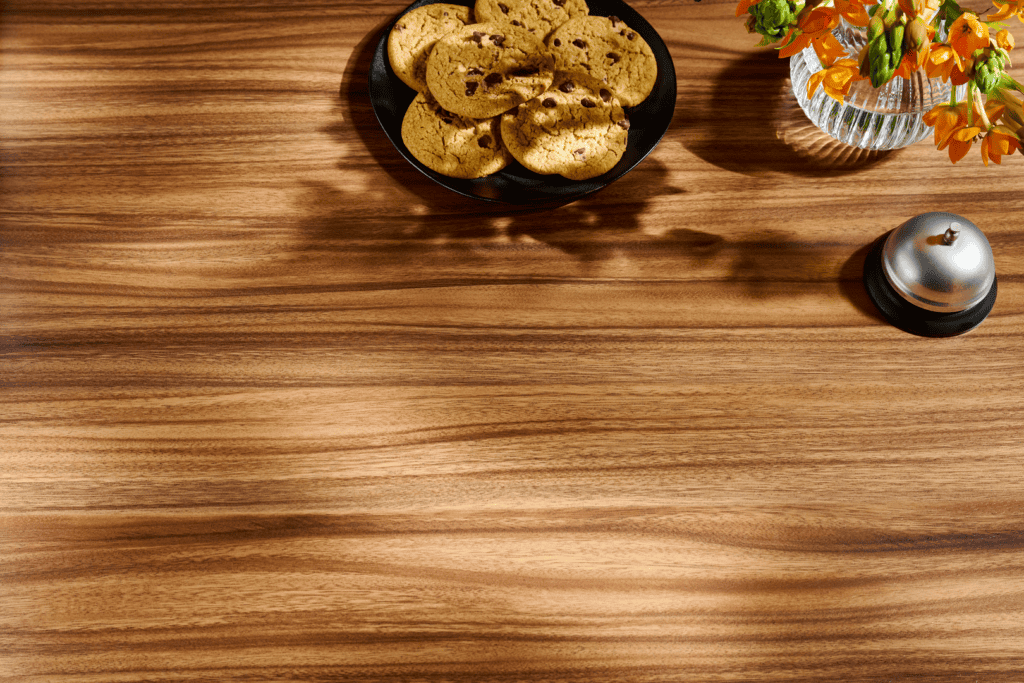
[19:28] Christelle Locat-Rainville: Yeah. It has evolved in an amazing way. And the good thing is we’ve also kept, I don’t want to call them old textures, but textures that have been around for a long, long time and that you can still get. If the wood grain is the hero of the design, then you want a texture that’s as realistic as possible. So it has evolved to where we have wood grains whose textures really follow the design of the decorative layer. It’s an all-in-one, and it really does look like a wood veneer, because it almost is one.
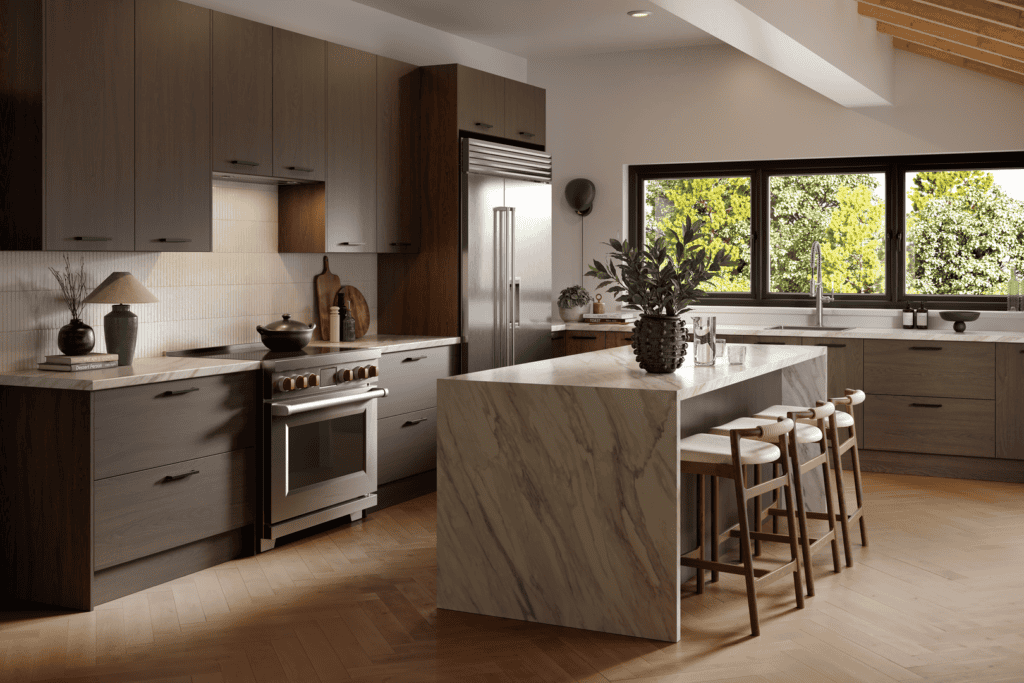
[20:12] Christelle Locat-Rainville: But I have to say the fabrication also makes a big difference. We can be as good as we want in terms of realistic textures and the gloss or matte aspect of the texture, but you also want to make sure the way it’s fabricated replicates the wood. If you have a 90-degree angle, you want the HPL sheet to continue the design. Then it looks amazing. I’m thinking about an island with a waterfall edge. If you take the time to join it at the perfect angle, no one’s going to know.
[21:03] Kenn Busch: Yeah. So in other words, no matter how great the design on the HPL looks, whether it’s a wood grain or a stone, it’s up to the millworker or the cabinetmaker to lay it out properly and create convincing edges, so it has the most realistic impact as a more sustainable option than the real materials can offer.
[21:23] Christelle Locat-Rainville: Realism is far, far away from what it was a hundred years ago. Textures, same thing. And that’s why HPL is still such a mainstream material, used in commercial settings and residential settings. It’s durable. It’s realistic. It’s also affordable. We can’t just pass by that. Why is it affordable? Because we’ve been using the same recipe, because we’ve evolved where we needed to evolve, and also because the material we use is accessible. We’re not using materials that are endangered or rare.
[22:12] Kenn Busch: Yeah. You were mentioning textures and the wood grain matching up with the print. Are you talking about synchronized textures, where, with wood grain as an example, every little tick in the texture lines up with a tick in the printed layer?
[22:31] Christelle Locat-Rainville: We can name it the cathedrals. The cathedrals of the wood grain are followed by the texture, so you’re going to see cathedral textures.
[22:41] Kenn Busch: I’ve seen woodworking professionals go, wow, I have no idea which one is which, until you drop your keys on it. Right? And one is going to scratch and the other one is not.
[22:55] Christelle Locat-Rainville: Yes, exactly.
[22:59] Kenn Busch: And talking about texture, there’s a visual element to texture that I think a lot of people don’t realize: the way the light hits it from certain angles. You can see a beautiful wood grain, but if the texture is flat, you’ll see it in the glare and say, okay, that’s probably not wood. Well, that’s also not a giveaway, because the way you have to finish real wood is very flat; otherwise it’s very fragile. The textures we’re able to supply in wood grains are so haptic, I guess is the term. There’s such a haptic interaction you have with them. It’s like raw wood, which you could never use in the real world because it would get dirty, with skin oils and all that. So our ability is not just to mimic or replace, but maybe to honor these natural materials and keep them for where they’re truly going to be loved and appreciated.
Young forests and captured carbon
[24:05] Kenn Busch: The great thing about the forests where we get all the fiber for the ingredients in the recipe that we cook into HPL is that those forests are designed by nature to be regenerated every 40 years or so. And we know from research that these young forests, these healthy, growing trees, are like hungry teenagers, right? They capture more carbon.
[24:33] Christelle Locat-Rainville: Painful? Disobedient? Sorry, sorry, that’s not what you meant.
[24:38] Kenn Busch: Always asking to borrow the car. Right. They are hungry. They absorb more CO2 from the atmosphere than an older or slower-growing tree does. These are fast-growing trees, so they’re very efficient air scrubbers, filtering CO2 out of the atmosphere, which they convert into sugars that become the tools for their growth. They release the oxygen. We all learned about photosynthesis in eighth grade or so, hopefully.
[25:16] Christelle Locat-Rainville: Yeah.
[25:17] Kenn Busch: They take that captured carbon, and that’s what literally builds the woody mass of the tree, to the degree that when you measure the carbon content of wood, it is 50% captured carbon. That’s amazing. It’s like building your next project out of 50% naturally captured carbon. Same if it’s lumber, same if it’s paper, same if it’s fine hardwoods. Wood is wood, and that’s what wood does.
[25:47] Kenn Busch: And carbon is one of the only things we really have to measure the relative impacts of different processes, products and materials. I’m guessing you probably have a life cycle assessment that points to this.
Life cycle assessment and the power of the spec
[26:06] Christelle Locat-Rainville: Yes. You just mentioned measuring. If you don’t measure, and you don’t know where you start, you’re not going to know if you’ve improved. Life cycle assessment is one of the best tools right now. Maybe there will be new tools in the future, but for right now, it’s the best tool to compare products, or actually anything, because it’s based on the same idea: you look at all the inputs of a product, the manufacturing portion where the product is really created, and then the outputs, and you put that all together. It gives you an analysis, a carbon footprint of a product, from the raw material to the end of life. You calculate the emissions from that cycle, and then at the end you look: is it positive? Is it negative? How negative is it? Because most of the time, besides wood, as we just talked about, it is negative, meaning you create more emissions than you store.
[27:09] Christelle Locat-Rainville: We hear a lot about embodied carbon, and the fact that the construction industry is responsible for about 40% of emissions, which is massive. So I think the positive side of this is that architects and designers, who create and who dictate what’s going to be included in a building, inside and outside, have a way to change the world. Listening to them, and providing them with the best tools, will eventually lead to better solutions, because they are the ones who can change the specs, and by changing the specs, you change the overall results.
Durability and reuse
[27:49] Kenn Busch: Another aspect of HPL’s sustainability story has to be its long-term durability. It’s incredibly durable.
[27:58] Christelle Locat-Rainville: If it’s used as an office desk, it’s going to last forever. But maybe the color that was chosen in the 1980s, and we can all picture some of those colors, maybe you don’t like that desk anymore. But is it still good? Yes. Is it still in good condition and durable? Yes. So reusing is the first thing everyone should think about. And I do understand that the brownish colors might not be trending… actually, they might be trending in the next few years, because everything comes back. So stay tuned for that 1980s desk.
[28:37] Christelle Locat-Rainville: But there are ways to continue to use those materials and that furniture, instead of saying, you know what, we’re renovating our offices, let’s get rid of everything and buy new because we want our employees to feel like they’re in a nice office and it’s 2026. I think there are ways to change the mindset so those ideas are accepted.
[29:02] Kenn Busch: Yes.
[29:03] Christelle Locat-Rainville: By the end users first, because the specifier can propose any type of idea, but if the end user doesn’t accept it, it’s going to go nowhere. So it starts by changing the mindset of the end users, and then I think we’re going to evolve and get somewhere with second-hand or used furniture. We can apply this to many things.
[29:32] Kenn Busch: I’ve done some stories on the reuse of commercial office furniture, especially on the West Coast, where there are all these tech startups that get a bunch of money and go out of business in two years, and all this brand-new furniture is suddenly, what do we do with this? So HPL helps keep this furniture fully functioning and very durable. Maybe trendy, maybe kitsch; it goes through different descriptors over its life.
[30:06] Christelle Locat-Rainville: Yes, exactly. Because it is so well made.
The substrate: particleboard and MDF
[30:09] Kenn Busch: One of the things I always think about when I’m trying to add up the downstream positives of something like HPL is the substrate used under it. It’s mostly particleboard, right? Again, one of the most sustainable building materials we have. Particleboard makes use of all the parts of a tree we can’t use for anything else: flooring, siding, construction lumber. After you harvest a tree and take those products out of it, you’ve still got about half of that wood fiber lying there. Particleboard comes along, and now we can use over 99% of that harvested tree, which comes back to the story of trying to honor the resources we use.
[30:58] Kenn Busch: And it’s also storing this captured carbon. Because of the density of the fiber in a product like particleboard, or even more so MDF, a cubic meter of particleboard stores about 1,100 kilograms of naturally captured CO2. Because of the density, that’s actually more than solid wood. The solid wood people hate this fact, but that volume of material is storing more captured carbon than its solid wood counterpart. MDF stores about 1,700 kilograms of naturally captured carbon, because it’s a little denser than particleboard.
[31:53] Kenn Busch: And in the LCAs done for those products, that is so much stored carbon that it more than offsets all of the other inputs that convert that wood fiber from the forest into, let’s say, a kitchen cabinet. After all of those processing steps, that kitchen cabinet is still storing more carbon. I like to use the phrase climate positive. It’s a climate positive material because it is literally keeping more carbon out of the atmosphere than was released in all the steps it took to turn a tree into a finished product.
Following the data upstream and downstream
[32:34] Christelle Locat-Rainville: And we only know that because it’s been measured through the life cycle assessment. That’s why data is so important. We probably guessed it was good, but we didn’t really know until it was measured. You just made the comparison yourself: MDF and particleboard are really similar products, used for the exact same reasons and fulfilling the same function, but they have different data in their life cycle assessments. That’s why it’s important to know about life cycle assessments.
[33:22] Christelle Locat-Rainville: It’s also important for the specifier to ask for those assessments, so they can look at them, compare, and choose the right product, or the right mix of products, to get the result they want. Just follow the data, calculate it, and you’ll end up with a result that’s comparable.
[33:48] Christelle Locat-Rainville: And that’s also why we need more companies to do it. To be honest, I think we’re getting there, because we’re being asked more and more to provide that information. And because we need to provide it, we need to get the data from our suppliers, and they in turn will have to ask their suppliers. So at some point we’ll touch everything, as you were saying, upstream, which is scope 3 upstream, and downstream, which is also scope 3. Looking downstream and upstream gives you the whole picture.
[34:33] Christelle Locat-Rainville: And for high-pressure laminate, of course you have to look at the laminate itself, but you also have to look at where it’s going to be used and what it’s going to be applied to. Not just the substrate. You also have to look at the glue, what type of glue is going to be used, and things like that. So there are a lot of pieces that have to be put together.
[34:51] Kenn Busch: The one common denominator, I like to say the carbon denominator, that we have to compare these different materials and processes is the carbon footprint. The embodied carbon, the overall carbon footprint. And I like to say, anytime the conversation is carbon, wood wins. And by wood, I’m talking about any kind of wood fiber: paper, solid wood, composite wood, et cetera. The conversation is always carbon, so wood-based products are always going to win.
Sustainability from the start, not as a trade-off
[35:23] Christelle Locat-Rainville: I hate it when people treat sustainability as a trade-off, because it shouldn’t be seen like that. The idea is to think about it at the beginning of a project and see what the options are. Okay, if I want my design to have a sustainability story at the end, what am I going to look at? And then look at the different materials. And now, hopefully, people know that HPL is a great response to that. We’ve said it: it’s made of paper. Paper comes from the wood industry, which absorbs CO2, and it’s not released once it’s captured. That’s the great news.
[36:08] Christelle Locat-Rainville: And HPL needs a substrate that is also great in terms of its sustainability story. And once you design something with it, it’s going to stay, unfortunately for some people, fortunately for others, forever, meaning it’s going to be good for at least the next 25 years. As we said, are you going to like your office desk in 25 years? I don’t know. It depends what you choose. So think about that when choosing the design you’re going to use with the HPL. How is it going to look five or ten years from now?
[36:46] Christelle Locat-Rainville: Because if people have sustainability in mind, we know they won’t need to change it. Whether we’re talking about furniture, cabinets or countertops, no matter where you use HPL, changing it is not going to be a necessity. It’s going to be a choice of design or preference. So choose brown if you like it, or choose something else if you don’t. But no matter what, we know it’s going to be good for a long time.
[37:25] Kenn Busch: Thank you so much for joining us. We hope we’ve improved your Material IQ by a point or two. This has been a production of Material Intelligence, LLC. All rights reserved.

Christelle Locat-Rainville, Marketing Director, Formica Canada, and Commercial Leader, Sustainability, Formica Corporation


Every episode of the Material IQ podcast explores in detail the materiality of the built environment: innovation, inspiration, and case studies from leading architects, designers, suppliers, and manufacturers with an emphasis on climate-positive outcomes in commercial and residential design.