

Podcast: Download (Duration: 41:23 — 94.7MB) | Embed
Subscribe: Apple Podcasts | Spotify | Android | RSS | More
About this episode
Formica Corporation’s brand historian Renee Hytry Derrington joins the Material IQ Podcast for a rare deep dive into the company’s century-long design legacy — from its 1913 origins as an electrical insulator to the birth of mid-century modern icons like the “Skylark” boomerang pattern designed by Brooks Stevens and Raymond Loewy’s postwar pastels.
Along the way: the real story behind matte finishes, ColorCore, and how paper (not plastic) built an industry — plus an unexpected sustainability angle tying Formica Corporation’s history to forest health and carbon storage.
A must-listen for anyone who wants the inside track on how one material shaped the American middle-class home.
The following podcast transcript was generated with Whisper AI and may contain errors.
Transcript
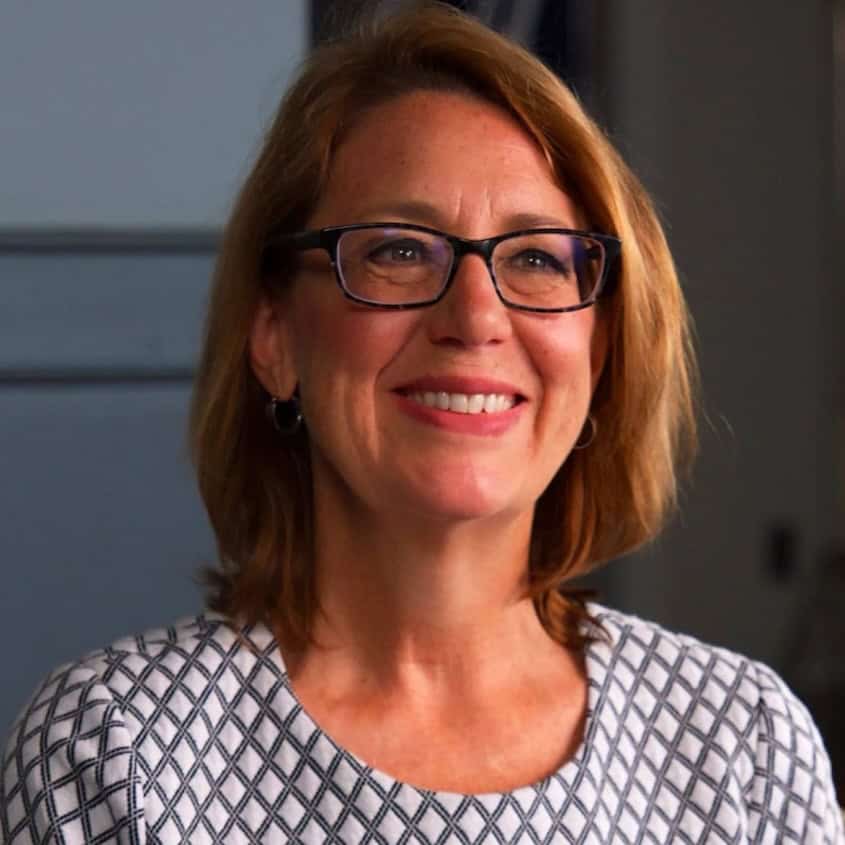
Kenn Busch in conversation with Renee Hytry Derrington, brand historian, Formica Corporation.
[00:00] Renee Hytry Derrington: It’s wild to walk into a space and then see something that your team worked on. It just is wild. And you can name the year and remember all the work that went into it. I would say that we were very lucky to have a design legacy throughout the years that led to the teams that we have today.
[00:28] Kenn Busch: A design legacy like no other. The Formica Corporation basically defined an entire category of materials: high-pressure laminates. Hi, my name is Kenn Busch. I’m the host of the Material IQ podcast. And that was Renee Hytry Derrington, who has been playing a role with the Formica Corporation since the 1980s — in one way or another, leading design, defining design, discussing design. And she has been a great influence on the way I approach my materials coverage in this industry.
[01:02] Kenn Busch: So this episode is very cool because it digs into the long legacy and history of materials and their role in defining the middle class and creating entirely new ways to think about design. And I’m super excited about this. But first, who is Renee?
[01:24] Renee Hytry Derrington: I’m the brand historian for Formica Corporation. But before that role, I’d spent more than four decades doing product design at some of the best manufacturers in the world with a historic background — Kohler Company and then Formica. At Formica, I worked for 36 years, ultimately leading the global design teams across five continents.
[01:49] Renee Hytry Derrington: During this process, I became deeply engaged in our history, just because design and history make sense. And we had a lot of wonderful designers and architects that were curious about our history. So now at this point, after rolling off my design roles, I’m focusing on documenting and archiving our company history.
[02:10] Renee Hytry Derrington: One of my most recent projects, which was a blast — I documented every single HPL design ever produced by the U.S. division of Formica Corporation, for a major donation of both samples and photography to the National Building Museum. So that’s kind of what I’m doing right now.
[02:32] Renee Hytry Derrington: But how did I get here? I started out with a degree in architecture from the University of Wisconsin–Milwaukee. And I did go back and get my master’s in industrial design at The Ohio State University. I really do believe in education, which is great being a historian, because you can teach things. So with that, I serve on advisory boards at Ohio State as well as the University of Minnesota.
Technical origins: a substitute for mica
[02:57] Kenn Busch: Formica has some sort of technical origins, right? So where do we start talking about the beginnings — the beginnings of the high-pressure world, and Formica’s leadership in making it what it is today?
[03:11] Renee Hytry Derrington: Well, ironically, the first order coming out of a rented Formica plant in 1913 was parts for the automotive industry. So go figure. I presented a paper at Ford last year for the International Business Archivists. And for me it was a great symbolic event, that here I was in the automotive industry, which was really the first customer of Formica.
[03:38] Renee Hytry Derrington: It was an interesting company because it was started by two engineers that worked for Westinghouse. They had developed some technology. What they did is they were looking to create a laminated insulating material that was to be a substitute for the mineral mica. So it was actually a sort of stone-like product that was used for insulation.
[04:04] Renee Hytry Derrington: Now, during that decade, there was a huge explosion of need for electronic equipment. So the demand for mica was more than the supply of that mineral. And it wasn’t consistent, and it was hard to get, and there were supply issues and all that kind of stuff. So our founders really had the opportunity to create kind of a wonder technical material that could be used in a lot of electrical-type appliances, as well as the automotive industry — timing gears, even shuttlecocks for making textiles. So it was a different kind of material to what we think about today. It really had a very interesting start on its way to becoming synonymous with modern durable surfacing.
[04:57] Kenn Busch: This original electrical insulator — it was kraft paper saturated with phenolic resin? Or was there a version of this before that combination became the basis for HPL?
[05:11] Renee Hytry Derrington: Fabric too. So it wasn’t always paper — it was also fabric. And we made shaped products also, so it wasn’t always flat. There was kind of a combination of things.
[05:22] Renee Hytry Derrington: The earliest presses that did make flat material were very small. I think they were like two by three, versus now the big presses out in the world are four, five, six foot by eight, ten, twelve foot long. We can actually produce a larger sheet than that. It’s just that it’s harder to handle. But early days, the presses were small. We have photographs of these small presses that the guys were working on. And even the founders worked in the plant — that’s what’s so cool about the early days. The founders were actually working on all of that.
Radios and the turn toward decorative
[05:58] Renee Hytry Derrington: Besides the automotive industry, we also were part of the early innovation of radios — telecommunications. I don’t know if you remember those old standup radios, those big standup radios where people sat around and turned the dial and they were able to connect with the world for the first time. That was one of our other first customers. And that’s where the product became flat, because we were used as the insulating board in the back. And then the fronts were wood.
[06:35] Kenn Busch: Oh, okay.
[06:38] Renee Hytry Derrington: The expansion of the radios is kind of where we led into our decorative side, because that same radio manufacturer started to want to use our materials on the front. And they were asking us if we would have the ability to make that black or brown sheet look more like a wood, because walnut and wood was the material of choice back in the 1910s and ’20s. So it was the radio industry that sort of helped us get into decorative.
[07:10] Kenn Busch: I don’t want to skip past the terminology here, or the company name. I think we kind of alluded to it, but literally the company name is because the material you were making was a substitute for…
[07:22] Renee Hytry Derrington: For the mineral mica.
[07:24] Kenn Busch: For mica, right. And so is that the honest version of where the brand name comes from? Because I actually got into a discussion with somebody a couple of months ago. They had a different take on it. I’m like, no, I’m pretty sure it’s because it was a substitute for mica.
[07:43] Renee Hytry Derrington: It is absolutely that.
[07:45] Kenn Busch: And it’s also become the quintessential reference point for high-pressure laminate, right?
[07:51] Renee Hytry Derrington: It is.
What HPL actually is
[07:53] Kenn Busch: I headed you off a little bit ago. You were about to tell us why the printed design became an integral part of what we understand as Formica, as the radio industry was asking you for something to replace wood.
[08:08] Renee Hytry Derrington: Yeah, exactly. Well, actually, I should probably step back and talk about the basic makeup of HPL — high-pressure laminate. Sometimes we do industry slang for it, right? HPL. But the laminate comes from the original process, where there were layers of either fabric or paper that were saturated in thermosetting resins and then pressed under heat and pressure. And with this, you have a very durable, flexible, wipe-clean surface. It’s a very strong surface. First, it was ideal for insulation materials. And then later, of course, we turned it into decorative.
Radio City Music Hall and the cigarette-proof laminate
[08:48] Kenn Busch: I want to ask you a little bit about the Radio City Music Hall thing. As you were saying that, it occurred to me: well, if you can make it in New York, you can make it everywhere. And you’re talking about Formica basically going global. But what was the material used? You said it was like a black lacquer. Where were they using it? And how did Formica execute it at that time?
[09:10] Renee Hytry Derrington: Well, we sold the sheets and it was used for furniture.
[09:12] Kenn Busch: For furniture, yeah.
[09:13] Renee Hytry Derrington: Black lacquer furniture, and then for wall paneling. And it’s interesting because Radio City Hall was not only one of the earliest installations of that material, the insulating material — it also was the first time in a major installation where, again, a product developed by Jack Cochrane…
[09:40] Kenn Busch: So a quick editorial note here. Jack Cochrane was Formica’s director of research in the 1920s and ’30s. He developed lighter-colored laminates in 1927. He introduced urea-based resins in the 1930s, which helped shift the company from electrical insulation into decorative surfacing. And as Renee is going to tell us, he was involved in some other very critical technical leaps forward for the company.
[10:09] Renee Hytry Derrington: Again, a product developed by Jack Cochrane was a no-scorch construction laminate. Or back in those days, you would call them cigarette-proof. In 1931, he created a laminate that included a thin layer of metal foil in between those papers. And this created the surface that was effectively cigarette-proof.
[10:34] Renee Hytry Derrington: And as you know, back in those days, smoking was very bold, right? Everybody smoked. There was a lot of smoking happening. And that was something that was always a category even wood and other materials had to deal with. So Radio City Hall was also one of the first installations of that cigarette-proof or no-scorch construction laminate.
[10:56] Renee Hytry Derrington: And when you think about it, everybody thinks of Formica for mid-century modern kitchen countertops. Actually, our earliest forays were more into the commercial segment — either transportation design, like big ships, trains, early airplanes, as well as some significant architectural installations that kind of affiliated with it, like bus stations and transportation halls, that sort of thing.
[11:28] Kenn Busch: Because of the durability? Because of the consistency?
[11:32] Renee Hytry Derrington: Yes and yes. Durability.
[11:35] Kenn Busch: And the value, I suppose, too, right?
[11:37] Renee Hytry Derrington: Yeah. And also in those days, because of our printing innovations, we were able to offer a substitute for what was considered very expensive and potentially rare materials. Like with the wood grains.
[11:52] Renee Hytry Derrington: Back to Jack in 1927 — he created a technique that he was able to patent to do light wood grains. Because imagine, if you’re using phenolic resins, the earlier ones were darker, like walnuts. But there was a trend for lighter wood grains in the latter part of the 1920s. So he also patented a technique for creating blonde wood grains, basically, that were very popular. So here the palette was opening up, that we could do both light to dark wood grains, substituting the very expensive sapeles and all of the different kinds of exotics out there, which was fantastic. So it was something that architects and designers were looking to use if they didn’t have access to those more expensive materials.
Printing on paper
[12:39] Kenn Busch: So the printing part — as that was introduced, you couldn’t print right on the brown or dark-colored kraft paper. You had to add a lighter-colored layer of paper to print on to carry some of these designs? How did this combination of materials evolve?
[12:59] Renee Hytry Derrington: Well, the original wood grains for the radio industry were on the dark kraft paper. And so therefore the images were more muted and not as crisp like they are today. Because today we have the ability to print photorealistically, which is fantastic. Depending on the texture, it looks like a real veneer. But in those days it was more of a challenge. And this innovation to do it on a lighter opaque surface actually helped lighten and brighten the print and allow us the wider range.
Why matte finishes exist
[13:34] Kenn Busch: And the evolution of the textures of laminates. I think one of the great things I learned from you was that stipple finish that was introduced maybe in the ’50s or something like that. That wasn’t necessarily an aesthetic decision — it was a durability decision. Am I recalling this right, Renee?
[13:55] Renee Hytry Derrington: I would say that in the early days, the laminate finish was more of a glossy finish. And in fact, when I joined the business, we used to have a buffing machine. So you’d press it in a matte finish and then you’d buff it. It was kind of an interesting technique. And you probably see that finish out there today. But it was more geared towards more glossy finishes.
[14:18] Renee Hytry Derrington: But then the matte — we call it matte, not super matte — the matte finish with that slight little subtle texture to it, that was meant to be a more forgiving texture in general. And matte texture came about, I would say, in the late ’40s, after World War II ended. So that was an innovation.
[14:43] Kenn Busch: And sometimes I speak in front of groups of students and I’m talking about that innovation. And I’m pretty sure I learned this from you, right? The idea that these little micro-pebbles, this little tiny stipple finish, was really to minimize the surface contact as people engaged with the material. And minimize — let’s say if you were going to scratch it, you only scratched just the very tops of those little stipples, instead of digging into what would be maybe a lacquer finish or a smooth, shiny finish. Am I remembering that right?
[15:21] Renee Hytry Derrington: Yeah. And it hides it, too. Most matte laminates are, I don’t know, 15 to 18 degree gloss. And that’s kind of the average gloss level of what your average scratch or scuff that somebody would do, overusing the material. So when you have a high gloss, which is at 90, if you take a deep scratch through it, it’s going to go down to that 18 degree gloss and you’re going to see it — versus with a nice subtle matte finish.
Melamine and the arrival of color
[15:52] Renee Hytry Derrington: And there’s lots of technologies out there today. So I need to say that this is the melamine technology, which was really key to the laminate industry in total. Today there’s so many more technologies out there that are anti-scratch and anti-fingerprint that are fantastic, like our Fenix product. So I’m talking back in the day where melamine was used.
[16:19] Renee Hytry Derrington: And actually, melamine wasn’t the original surface — not until about 1938. When melamine was available, that allowed us to create the brighter colors that you wanted to see. Before, it was more of a muddy resin in general. So really, the introduction of melamine gave us the color clarity, the heat resistance that was needed, and the durability. And that allowed us to do the wonderful light and dark patterns and much more brilliant colors than we had even before.
[16:56] Renee Hytry Derrington: And that’s why, when you think about mid-century modern — besides the war happening right until ’45 — all the stuff that came after that, there was a lot of light aquas and pinks and all those lovely colors being used at the time.
[17:09] Kenn Busch: So just to make sure we’re tracking on the terminology here: when you say melamine, you’re talking about melamine-saturated decor papers, right? Because the resin used in the core, the kraft papers, is a phenolic resin, which cures darker. But it’s more cost-effective.
[17:28] Renee Hytry Derrington: Well, it has some benefits that melamine doesn’t.
[17:31] Kenn Busch: Ooh, do tell.
[17:31] Renee Hytry Derrington: I mean, the reason we have that core is that the phenolic resin is very flexible. So the sheets won’t break. Melamine has a tendency to be less flexible.
[17:42] Kenn Busch: Brittle.
[17:43] Renee Hytry Derrington: So by marrying the two different kinds of resins, we get the best of both worlds. We get a durable, clear topcoat that’s hard and scratch-resistant, but then you have a nice flexible sheet so that the fabricators and the millwork houses can easily work with them. We can roll them up in a hat box and ship them to your house directly, for instance. So all the resins have a specific purpose.
Postwar design and the American middle class
[18:08] Kenn Busch: So on this design journey — let me know if I’m kind of skipping over — I really want to get into talking about the colors and the designs that made the whole mid-century design movement pop. And Formica’s role in that, and really shaping what people thought of as the emergence of the American middle class, which was something brand new in the world.
[18:33] Renee Hytry Derrington: Even though we were starting on that journey towards decorative laminates in the early ’30s, our main focus was more the commercial segment. Like I said, transportation and commercial buildings and that sort of thing. Our plant was utilized for the war effort, and we actually went back to our origins by creating gears and propellers for airplanes, and equipment for radios. So our plant totally shifted for World War II efforts.
[19:05] Kenn Busch: So cool. But after the war?
[19:08] Renee Hytry Derrington: We were able to step back into being decorative again. And one of the first things that we did was we worked with — he’s not as well known, unfortunately, but he was one of the early modernists — his name was Morris B. Sanders. We worked with him. He lived in New York City. He put up one of the first modern brownstones in the city. He created a design with us called Moonglow, that is patented. Moonglow, G-L-O. This was done in 1948.
[19:38] Renee Hytry Derrington: So this is kind of the first partnership we had with an outside designer, to help us understand what the new aesthetics of the coming age were. He was the first one that we started working with. Then we had two very famous industrial designers that were using our material.
Brooks Stevens, Luxwood, and Skylark
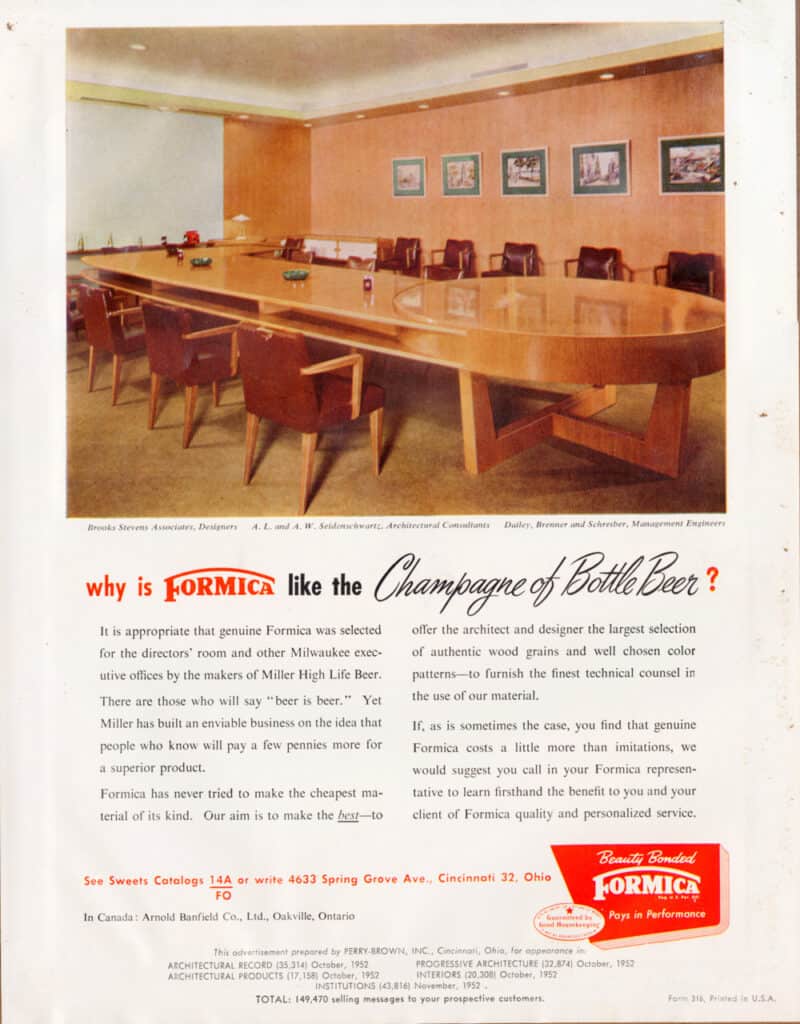
[19:56] Renee Hytry Derrington: First, we worked with an industrial designer named Brooks Stevens. And me coming from the University of Wisconsin–Milwaukee, growing up in Wisconsin, I’m so proud to say that Brooks Stevens from Milwaukee was a customer. He was working with our laminates to design trains — commuter trains. So he was working on the Hiawatha train that went between Chicago, Milwaukee, to Minneapolis, and then out west. And with that, he was specifying our materials.
[20:34] Renee Hytry Derrington: Because he understood our materials, we then asked him — because he had opinions. You know designers. They have opinions about things. Since he gave us his opinions, we said, can we hire you? And so he was our second designer that was basically helping the internal R&D folks create appropriate ranges for the time.
[20:58] Renee Hytry Derrington: And a designer on Brooks Stevens’ staff was the one that first penned the boomerang, which in those days was called Skylark. That became one of the most iconic laminate designs, if not iconic imagery of the era in general.
[21:18] Kenn Busch: And Brooks Stevens was pivotal in turning Formica into the company we know today. How is that?
[21:25] Renee Hytry Derrington: He was the one that said, well, why don’t you go back to your photographic images of wood grains? And he came out with a line called Luxwood, which really kind of went crazy all over. I’ve seen it all over. It was a straight-grain sapele, but then they colored it in many different colors. And that Luxwood really went into the marketplace, kind of going back to our roots of printing the actual wood grain design.
[21:54] Renee Hytry Derrington: And then, of course, he did this lovely Skylark design, which became one of the most emblematic design-language pieces of the era. And that was in 1951. So now we’re kind of heading after the ’40s and really getting into that mid-century modern period.
[22:14] Kenn Busch: And that was the Skylark, or the boomerangs, right? It was the little boomerang shapes that were kind of overlapping. It kind of looked like a field of these, not even oriented in a specific direction. It was just fun, chaotic. How do you link that kind of abstract design coming out of nowhere and relate it to the energy of the post-war period and the new American middle class? And, hey, we’re something new here, right? Have people thought about the cultural connections between Formica’s position in the world and suddenly mass-marketing these brand new design ideas? To me, there’s so much energy in that moment in time.
[23:05] Renee Hytry Derrington: You have to call it the atomic age, too. The atomic age.
[23:08] Kenn Busch: Bingo. Right, yeah.
[23:10] Renee Hytry Derrington: There you go. I mean, all the technology that was developed during World War II — microwave, the atom bomb — there’s all these new technologies that happened because of the war effort that then started to make its way into the consumer world.
[23:24] Renee Hytry Derrington: Noguchi designed a very famous table, with their kind of boomerang-shaped base. It’s a Herman Miller piece. It’s beautiful. It’s lovely. I have one myself. But there was a lot of design during those days kind of taking on that very playful role, a very optimistic role. And the colors that we did, it was amazing.
Raymond Loewy and the pastel explosion
[23:51] Renee Hytry Derrington: When I think about it, the Brooks Stevens colors were quite nice. There was a white and a gray and a pumpkin, but they were more muted. It wasn’t until our next interaction with a famous industrial designer named Raymond Loewy that we really went all into the pastel colors. Pastel yellow, light aqua, medium aqua, light blue. We got into those very playful colors with the same design.
[24:24] Renee Hytry Derrington: And that’s why people think, oh, Raymond Loewy designed your boomerang. No, he recolored it. He joined our organization in 1954. And he was very famous for a lot of automotive design and some of the biggest brand logos out there. TWA. He designed the Lucky Strike pack. The Coca-Cola bottle he designed. So he was very influential too. And design was kind of exuberant at that point.
[24:55] Kenn Busch: I love that term, exuberant. There’s nothing we can’t do. There was a time, I think, where people said, come over and see my Formica kitchen.
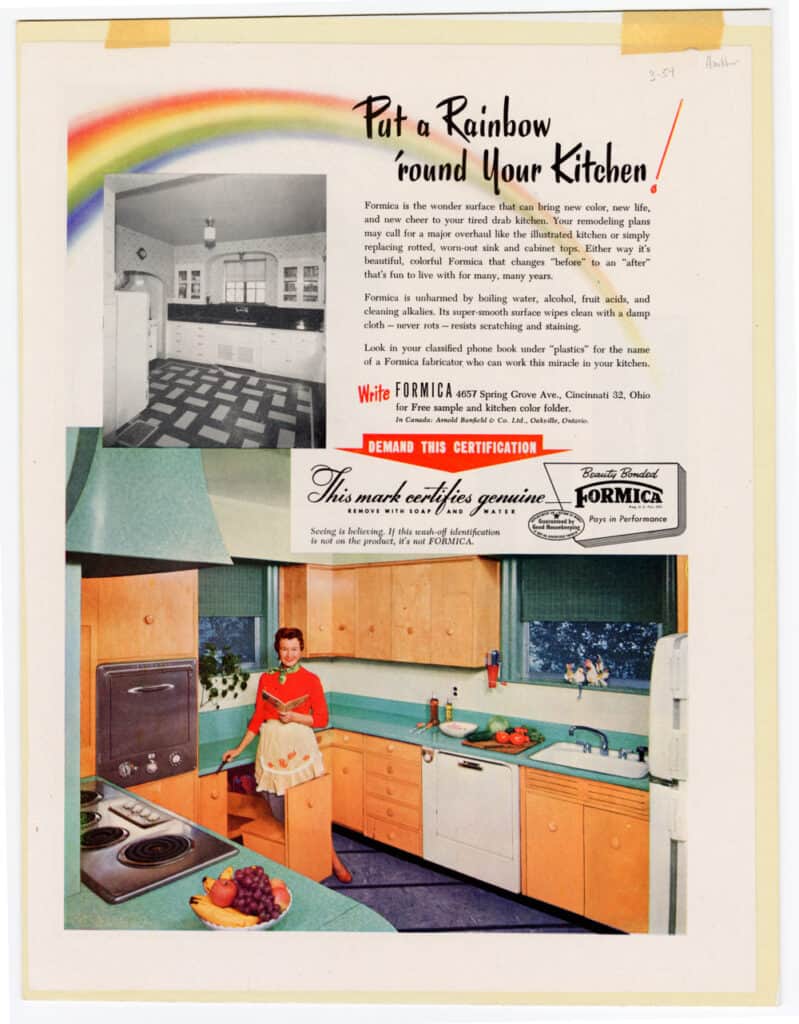
[25:06] Renee Hytry Derrington: You’re not going to believe how gorgeous it is. We were advertising quite heavily in the ’50s. Our range, which before World War II was more limited, after World War II expanded immensely. And you saw all of these color options — clear colors, bright colors, optimistic colors.
[25:27] Renee Hytry Derrington: White became an important thing. Actually, our white that we have in our range today, 949 White, which is an industry standard — that was a Raymond Loewy-inspired design in 1954. It was very hard to make white pre-’50s. It wasn’t until there was a stable titanium dioxide element that could create good whites, and therefore good lights, and therefore good pastels. It was so interesting. There was this technology of materials that led to better designs that then could reflect the optimistic era that came after World War II.
[26:07] Kenn Busch: Well, that’s such a great point, because titanium dioxide is what gives paper its whiteness, right? That’s how you get blindingly white shades of paper. And then now you can print on that to create laminates. And it opens up, like you say, a whole palette of vibrant designs.
[27:27] Renee Hytry Derrington: When I look back at our history and I look at color trends — I recently was kind of tracking this. I know the historians at Ford Motor Company, Kohler Company. I know their historians very well. I’ve been in their archives too. And comparing what Formica was introducing through the decades against Kohler, against the automotive industry, my friends at Whirlpool even — we all kind of were paralleling the same thing, as the technology allowed us to create whiter, brighter designs, especially in that mid-’50s time period.
[26:59] Renee Hytry Derrington: And it’s so great because it just really allowed the consumer to have this beautiful space that represented modernity and optimism and the future. It was just a really brilliant time for design. And I think that’s why people love looking back at mid-century modern design now, because it represented all that positivity.
[27:19] Kenn Busch: Right. It was the explosion of the American century. The leadership of our companies, the post-war generation with cash to spend, and wanting to create beautiful environments for themselves. And the easiest way to do that was to work with materials from companies like Formica. And effective marketing made it like, okay, those are the Joneses, got to keep up with them, they’ve got Formica. And it snowballed and became something that now is an era that everybody looks back on with fondness, and maybe even envy now.
The House of the Future and the whole-house ’60s
[28:10] Kenn Busch: So where are we going from there? We’ve got these abstract designs that are introduced. You’re able to help people use gorgeous wood grains in areas where…
[28:21] Renee Hytry Derrington: Marbles.
[28:22] Kenn Busch: And stones, right? So let’s just keep going with the evolution of these material and design innovations.
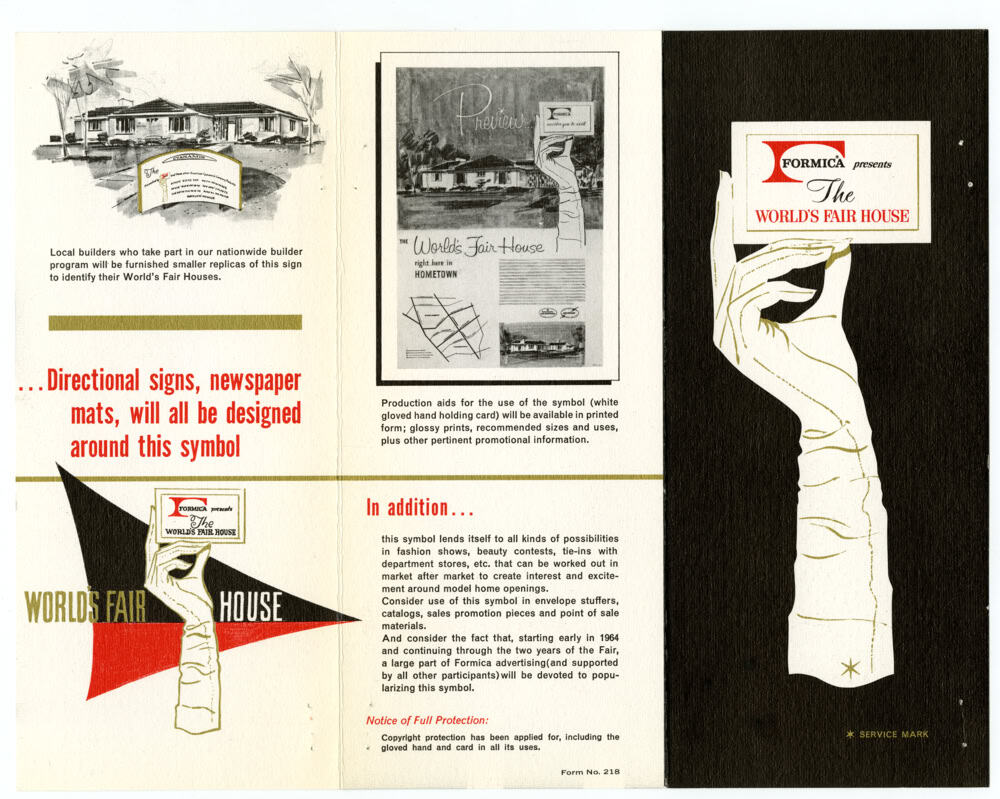
[28:31] Renee Hytry Derrington: Well, the relationship with Raymond Loewy went up until 1964, which is when Formica had the House of the Future at the World’s Fair in New York. And so that was a great representation that included materials that were even on the exterior. So our materials were on the exterior, to the interior furniture. And it had new sorts of layouts for the kitchen and the children’s room, and new kinds of rooms in general.
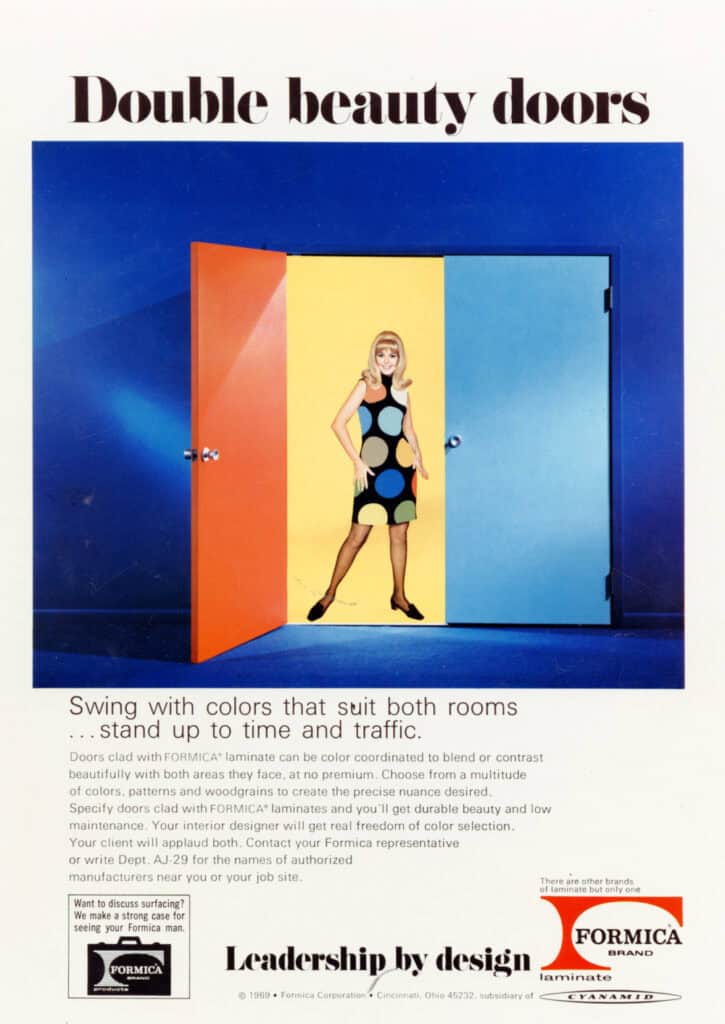
[29:01] Renee Hytry Derrington: And that really went to the forefront and propelled Formica from the ’50s into the ’60s, which was more of the whole house. The ’50s was more about the kitchen, and then the ’60s went to the full house. There you saw Formica laminate being used for paneling. People remember the ’60s, wood paneling — that was our material then. And we had shower system kits as well as the paneling. So we were expanding the types of laminate that could be used in different applications, both horizontally and vertically at that point.
Durability, and Color Core
[29:41] Kenn Busch: You mentioned being able to be used for showers and whatnot. The durability of the material is something we haven’t really touched on. I mean, the phenolic-resin-based core of kraft paper and the melamine-resin-based decorative layer — it’s waterproof, it’s cigarette-proof. It’s really something that the materials world hadn’t seen up until then.
[30:08] Renee Hytry Derrington: And again, along with the impact resistance. Practically indestructible.
[30:14] Kenn Busch: How do we talk about the explosion of application possibilities? I mean, it started out in commercial spaces, like you said, which I did not realize, and then in transportation. And the fact that a lot of that stuff is still out there.
[30:30] Renee Hytry Derrington: We did try residential before World War II. There are some indications where we were doing the whole dinette table and matching chairs. We were trying to get furniture manufacturers to use our product and they were hesitant, because they were used to wood tables. So we actually created kits where we had the finished top and sent the legs along with it. So we were starting to go into the residential segment before World War II.
[30:57] Kenn Busch: What were the main design leaps since the ’40s, the ’50s?
[31:04] Renee Hytry Derrington: We also created an innovation called Color Core. And this was for the solid colors, not the prints. We haven’t talked about solid colors — the blues, purples, oranges, which is a huge part of our sales. But in 1983, we introduced Color Core, and that eliminated that brown line to create a color-through construction, which was fantastic. And that really came about through the engagement of designers again — designers and architects.
It’s mostly paper
[31:36] Kenn Busch: Every time I think about the movie The Graduate — he says, plastics.
[31:46] Renee Hytry Derrington: It’s interesting, because the majority of our product is actually paper.
[31:50] Kenn Busch: Well, and that’s a great thing to clarify, right? Because sometimes it’s called plastic laminate, or P-Lam, and some of these other terms that really are not accurate. It’s mostly paper fiber, right?
[32:01] Renee Hytry Derrington: Absolutely.
[32:03] Kenn Busch: So what is kind of the approximate ratio there?
[32:07] Renee Hytry Derrington: For the construction of a sheet of laminate — we look at the thickness of it, or somebody might say the brown line with the decor sheet on it. We have the kraft paper and the decor sheet, and then we have a melamine layer that is carried by a sheet of paper too. If it’s a print, it’s approximately 70 percent paper and about 30 percent the resins — the clear resins, the melamine on top, and then the phenolic that makes it strong and durable and flexible and impact-resistant.
[32:40] Renee Hytry Derrington: So you can see that really our product is more paper, and paper is a great renewable resource. For years, the industry has been very supportive of sustainable forestry. And even recycled content — we’re able to use recycled content in various elements of various papers. So paper is key for the construction of plastic laminate. Like they used to say — plastic laminate.
Paper, forests, and the sustainability story
[33:08] Kenn Busch: Well, you know, it’s these marketing terms, because plastic was a wonderful jet-age material at one point. So it was something we all wanted to brag about. But the fact that the fiber that goes into paper — I’ve been spending a lot of time in the forest with foresters over the last few years. And I was in a gorgeous stand of tall, straight sugar maples that had been managed a few years before for the pulpwood. They took all the pulp trees out of it. And that was the only reason these maple trees were allowed to grow so tall and straight, because they cleared the canopy, opened up the space.
[33:44] Kenn Busch: And I was a little bit blown away, because the guy is standing there telling me: look, next time you’re in a bathroom in an airport and you’ve got the air dryer and you’ve got the paper towel machine, use the paper towel machine. Because if we don’t monetize the use of the paper, the pulp trees, we aren’t going to be able to care for these hardwood forests. So the use of paper helps our forests be healthier. The fact that we are a paper-based industry is an absolute plus for the environment and a great sustainability story.
[34:17] Renee Hytry Derrington: Yeah, no, absolutely.
[34:20] Kenn Busch: And this might be a great way to transition into what I always thought was the untold sustainability story of Formica. Beginning with the replacement of mineral materials as electrical insulators — now we’re doing it with phenolic-resin-saturated papers because it’s a better product. It’s more consistent. At that time it was probably more cost-effective, but I don’t think anybody was thinking in terms of, well, this is a more sustainable alternative for mica. It’s just that it was a more consistent and accessible version of the material.
[35:01] Kenn Busch: And there’s so many different ways to talk about sustainability when we’re talking about Formica, because we’re also talking about the replacement of rare and fragile wood grains, right? I remember doing some stories with you in the nineties, Renee, where we were talking about zebrawood, and species that you could not…
[35:22] Renee Hytry Derrington: Rosewood. Rosewood, yeah.
[35:23] Kenn Busch: All of them. You could not legally get your hands on those woods or veneers to make furniture out of. But your design suppliers, you worked with those guys to get gorgeous scans and then reproductions of these absolutely gorgeous woods that people desire, but aren’t allowed to use anymore. Now it can be part of their design vision, because we can replicate them and turn them into something that is actually safe to use, more practical to use, budget-friendly and legal to use.
[35:59] Kenn Busch: Because I think I remember a presentation once where somebody was showing a bunch of these different wood species and saying, these trees are on the same endangered species list as the white snow leopard or whatever.
[36:15] Renee Hytry Derrington: Yeah. The red list. The bad red list.
[36:17] Kenn Busch: The red list. And so this was a way to save a very rare and fragile resource by imitating it. People desire these things. So we were able to use them without actually threatening the original material. So we’re using paper to create the high-pressure laminate. We’re imitating rare and fragile wood species. And then…
[36:41] Renee Hytry Derrington: And stones. That’s another thing.
[36:43] Kenn Busch: And stones. I never think about stones.
[36:46] Renee Hytry Derrington: Yeah. It’s really interesting, because granites or real stones became popular in the nineties. But they came from far away. They were mountains in Brazil, and you’re shipping these big blocks all over the place. And we were very lucky to kind of capitalize on that trend. Scanning technology got better in the 2000s, and we were able to scan a full slab and then reproduce that. So it was like real granite. It was like real marble.
[37:17] Renee Hytry Derrington: So no longer were you in some foreign country, chunking out a block, shipping it, cutting it up, and then creating your countertop. It’s another wonderful way for us to create a rare visual that makes you feel like you have a luxury granite, without the negativity of cutting a hole in the side of a mountain.
[37:41] Kenn Busch: Exactly right. The sustainability story is not cut and dried in our industry. We can come at it from so many different angles: the materials we are replacing, the materials we build with, and then in the case of a high-pressure laminate, the materials that support it out in the real world. If it’s particleboard or MDF or some other composite wood material — those are the only building materials we have that are truly what they say, carbon negative or climate positive. Bottom line is they actually store more carbon than is released in the production of those materials.
[38:18] Kenn Busch: So the finished countertop with the Formica surface on it is a climate-positive material, or carbon negative, even after all of the processing steps that convert these raw materials into a cabinet, a countertop, a worktop, a wall panel. We are still storing more carbon in that finished product than is released in getting it from the forest to the furniture.
What’s next
[38:44] Kenn Busch: But let’s bring it back to design. We’ve been through some of the major social trends over the century, and we’ve talked about some of the top industrial designers who’ve been involved. What’s next?
[38:56] Renee Hytry Derrington: It’s interesting to look at style trends, even since I’ve been in the industry in the ’80s. When I first joined the category, the most popular looks were solid colors and, I’m going to say, organic patterns. Wood grains, not so much. The commercial segment was still going with veneer and real wood at that point.
[39:21] Renee Hytry Derrington: But it’s been a total flip now. Wood grains are the hottest visuals in the architectural community, because of some of the benefits that you’re talking about — the biophilic aspect, the sustainability offering, instead of going after raw veneer, which is difficult to work with. And you don’t know if it’s a good thing to be cutting down those kinds of trees.
[39:49] Kenn Busch: And the VOCs in the finishing process. And the inconsistencies there, right?
[39:53] Renee Hytry Derrington: Exactly. Or inconsistencies if you’re designing a restaurant chain — are you going to be able to get consistency throughout, to support your corporate image? Would you get consistency from Seattle to Chicago to Charlotte? Will you get the same look across with veneer? It’s very difficult. So the wood grain category for Formica laminates has been a boom.
[40:23] Kenn Busch: We love wood.
[40:24] Renee Hytry Derrington: And that’s how we started. That’s the funny thing about it. That’s exactly how we started. Our first visual imagery was wood grains.
[40:31] Kenn Busch: Thank you so much for joining us. We hope we’ve improved your Material IQ by a point or two. This has been a production of Material Intelligence, LLC. All rights reserved.

Check out these vintage Formica ads
Images provided by Formica Corporation. These images were obtained from the Smithsonian Institution. The images or its contents may be protected by international copyright laws.
All images sourced from The Formica Collection, Archives Center, National Museum of American History, Smithsonian Institution. Permission for use of this image can be obtained by contacting [email protected].
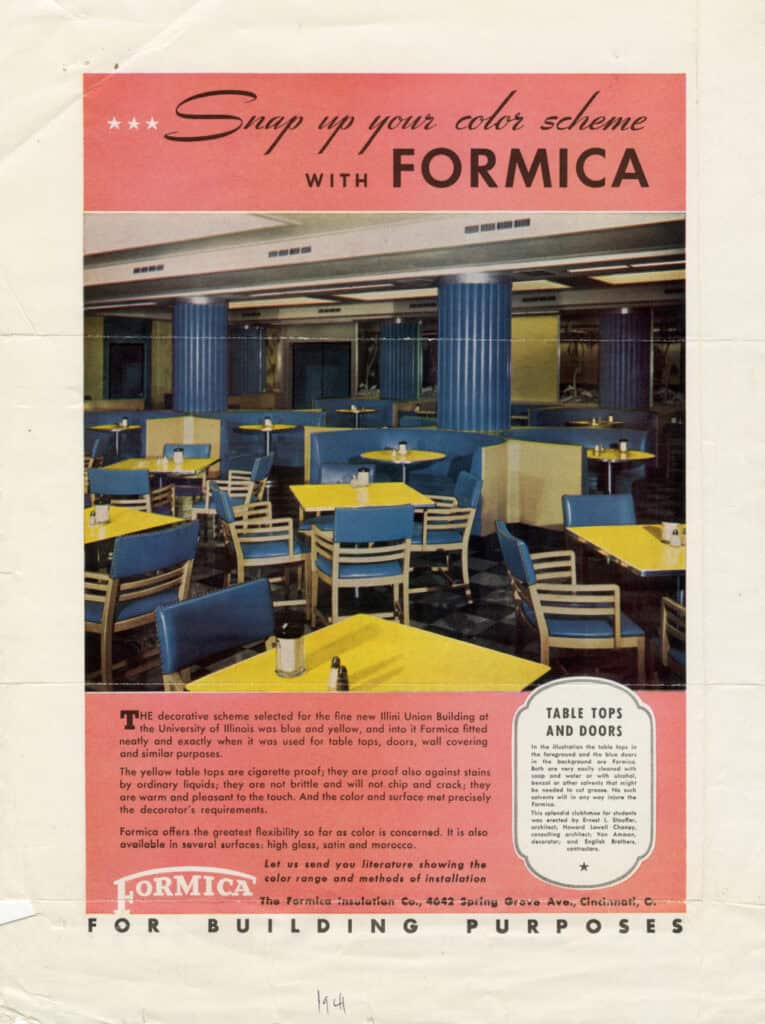
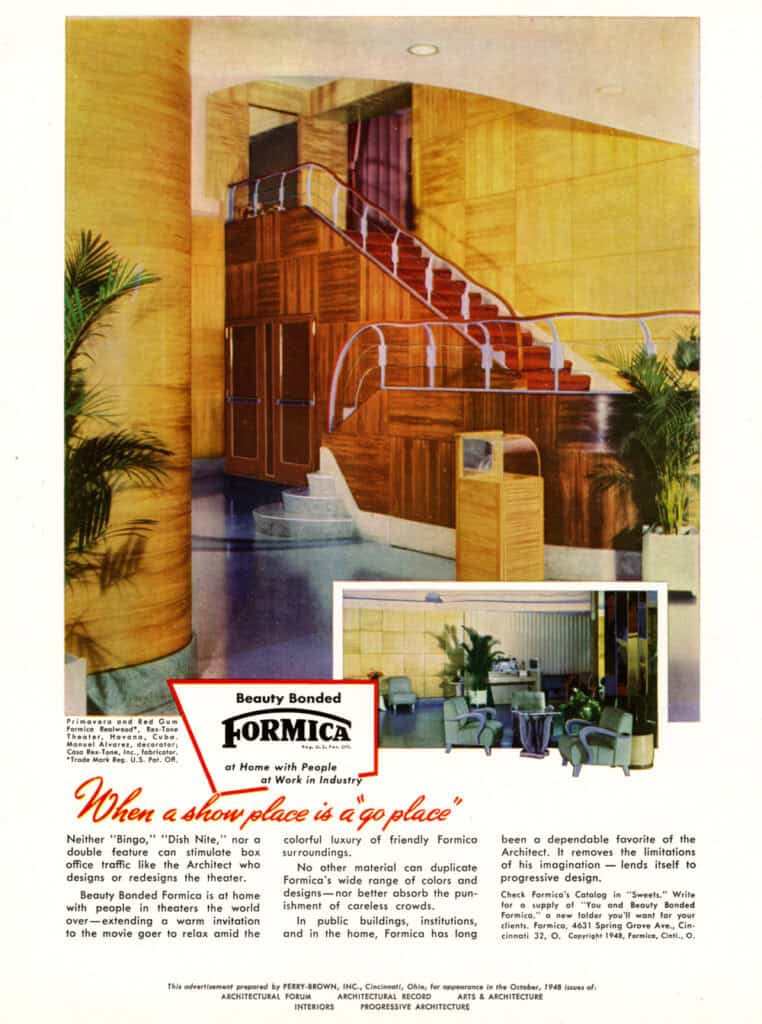
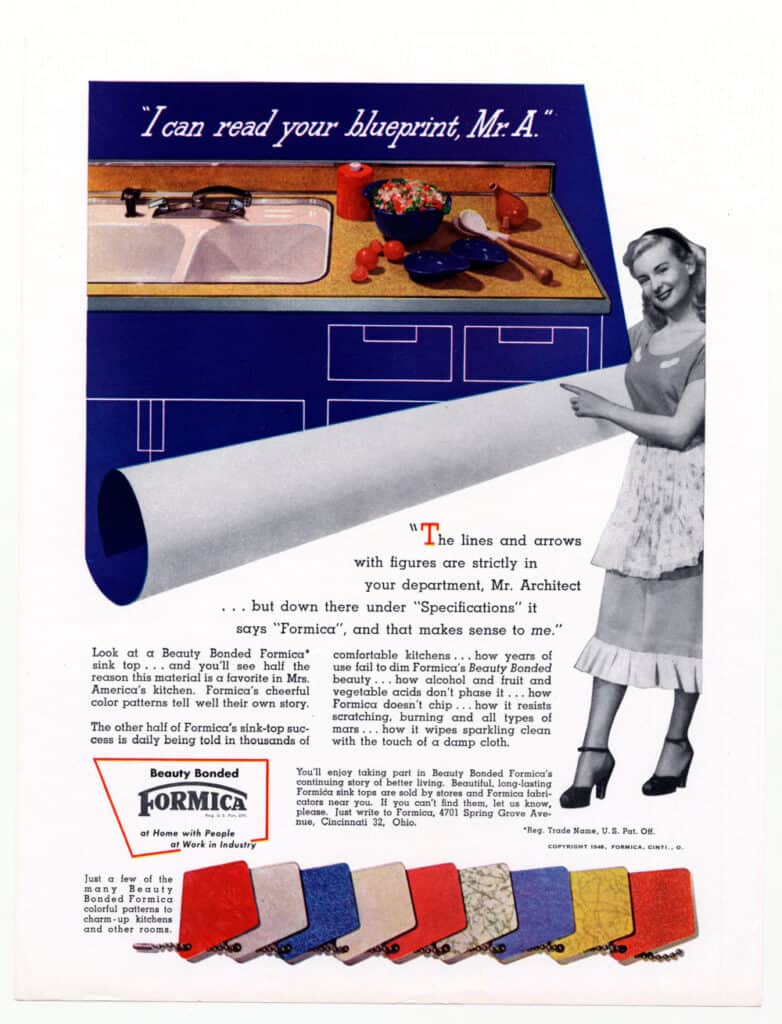
Images provided by Formica Corporation, obtained from the Smithsonian Institution. The images or its contents may be protected by international copyright laws.
Citation: The Formica Collection, Archives Center, National Museum of American History, Smithsonian Institution. Permission for use of this image can be obtained by contacting [email protected].

Every episode of the Material IQ podcast explores in detail the materiality of the built environment: innovation, inspiration, and case studies from leading architects, designers, suppliers, and manufacturers with an emphasis on climate-positive outcomes in commercial and residential design.



















































So impressed with laminates today. Some you cannot even tell if they are laminates, they are so real looking. Thanks for the history lesson!